

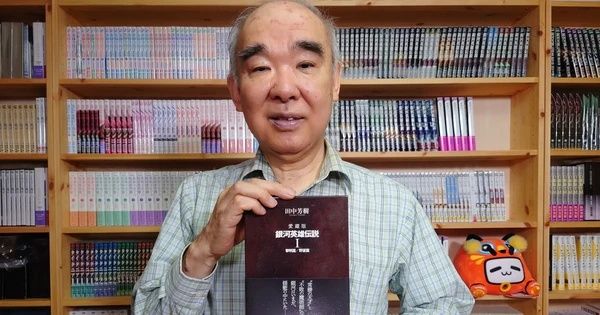
A Year in Silence: The Untold Health Battle of 'Legend of the Galactic Heroes' Creator Yoshiki Tanaka

📷 Image source: animenewsnetwork.com
A Literary Universe Paused
The Sudden Silence from a Prolific Mind
For over four decades, Yoshiki Tanaka built sprawling empires of ink and imagination. His monumental space opera, 'Legend of the Galactic Heroes,' defined a genre, spinning a tale of galactic war, political philosophy, and destiny across more than ten million printed copies. Then, in late 2024, the flow of words from one of Japan's most revered novelists abruptly stopped.
Fans and the publishing industry were left with only silence and speculation until November 30, 2025, when the truth was revealed. According to a report from animenewsnetwork.com, Yoshiki Tanaka, 74, suffered a debilitating subarachnoid hemorrhage—a severe type of stroke caused by bleeding in the brain—in the autumn of the previous year. The news, confirmed by his management office, S&L Planning, explained the author's complete withdrawal from public life and all professional activities.
Decoding the Medical Crisis
What a Subarachnoid Hemorrhage Means
A subarachnoid hemorrhage is a life-threatening medical emergency where bleeding occurs into the space surrounding the brain. This space, called the subarachnoid space, is filled with cerebrospinal fluid that cushions the brain. The sudden influx of blood creates intense pressure, causing a devastating headache often described as 'the worst headache of one's life,' and can lead to brain damage, coma, or death.
The severity of such an event cannot be overstated. Recovery is typically long, arduous, and uncertain, involving intensive medical care and rehabilitation. For a creator like Tanaka, whose work demands immense cognitive focus, memory, and linguistic precision, the implications are profound. The report from animenewsnetwork.com, dated 2025-11-30T15:26:01+00:00, explicitly states that the hemorrhage has left Tanaka in a condition where 'the resumption of his writing work is unforeseeable,' a phrase that casts a long shadow over the future of his literary endeavors.
The Legacy Left in Orbit
Tanaka's Unfinished Galaxies
The announcement immediately raises questions about the fate of Tanaka's numerous ongoing series. He is not solely the author of 'Legend of the Galactic Heroes' (known as 'Ginga Eiyū Densetsu' in Japanese). His bibliography is a vast constellation of series, including 'The Heroic Legend of Arslan,' 'Sohryuden: Legend of the Dragon Kings,' and 'Typhoon of the Gurakan,' many of which were actively being written. These are not merely books; they are complex, intergenerational narratives with devoted fanbases.
According to the source, his management office confirmed that all serializations and writing projects have been halted indefinitely. This leaves multiple storylines frozen in time, their conclusions now hanging in the balance of the author's health. The cultural impact of this hiatus extends beyond readers to the broader media ecosystem, including anime, manga, and game adaptations that often rely on the source material's progression.
A Genre Forged in Ink
How Tanaka Redefined Space Opera
To understand the weight of this news, one must grasp Tanaka's unique position in literature. Before the modern boom of translated 'light novels,' Tanaka was crafting dense, politically sophisticated space operas that drew direct inspiration from European history, particularly the Prussian military tactics and the dynastic conflicts of the Holy Roman Empire. 'Legend of the Galactic Heroes' is famously a story without traditional villains, instead presenting a clash of ideologies between the autocratic Galactic Empire and the corrupt Free Planets Alliance.
His work stood in stark contrast to the more common adventure-driven sci-fi of the time. Tanaka's novels asked philosophical questions about democracy, autocracy, meritocracy, and the 'great man' theory of history, all while orchestrating grand fleet battles involving thousands of ships. This intellectual rigor earned his work the label of 'hard' space opera and cultivated a uniquely dedicated, often older, readership that appreciated the narrative's complexity and moral ambiguity.
The Ripple Effect Across Media
Adaptations and an Industry on Hold
Tanaka's influence is not confined to bookshelves. His works have spawned some of the most ambitious and respected adaptations in anime history. The original 'Legend of the Galactic Heroes' OVA (Original Video Animation) series, produced between 1988 and 1997, runs for 110 episodes and is frequently cited as one of the greatest anime series ever made for its faithful, novelistic approach. More recently, a new anime adaptation titled 'Legend of the Galactic Heroes: Die Neue These' began in 2018, re-introducing the saga to a new generation.
Similarly, 'The Heroic Legend of Arslan' has seen multiple anime and manga adaptations. These projects represent significant financial and creative investments for studios like Production I.G and Kadokawa. With the source material's future uncertain, the long-term planning for these adaptations enters a state of limbo. Producers must now consider whether to create anime-original conclusions, place projects on indefinite hold, or proceed with existing material while hoping for the author's recovery—a complex business dilemma rooted in a human tragedy.
The Unseen Burden of a Creator's Health
A Common, Yet Seldom-Discussed, Industry Reality
Tanaka's situation highlights a pervasive but often quietly handled aspect of the creative industries, particularly in Japan where many iconic manga artists and novelists work under intense, serialized pressure for decades. The health of a single creator becomes the linchpin for massive franchises, affecting hundreds of employees in publishing, animation, and merchandising. History is dotted with examples: the passing of 'Berserk' creator Kentaro Miura, the hiatuses of 'Hunter x Hunter' due to Yoshihiro Togashi's back problems, and the death of 'A Song of Ice and Fire' novelist George R.R. Martin.
This model creates a fundamental vulnerability. While fans eagerly await new chapters, the physical and mental toll on creators can be immense. Tanaka's hemorrhage, occurring in his mid-seventies after a lifetime of writing, underscores that this is not merely a question of deadlines but of human endurance. The industry has seen gradual shifts toward better support, but the Tanaka case is a stark reminder that the connection between a creator's well-being and a story's life is absolute and fragile.
The Ethics of Continuation
Could Another Writer Finish the Saga?
In the wake of such news, a difficult question inevitably arises: should another writer be allowed to complete Tanaka's series? This is a deeply contentious issue that touches on artistic integrity, fan expectations, and legal rights. Some franchises, like the 'Dune' series, have been continued by other authors with mixed reception. In manga, the series 'Slam Dunk' took a different path, ending prematurely but definitively due to the author's health, preserving its artistic purity.
According to the information available from animenewsnetwork.com, there is no indication that such a plan is being considered for Tanaka's works. The report focuses solely on his condition and the halting of projects. Any decision would likely involve his estate, publishers, and the deeply held sentiments of his readership. For a body of work so distinctly shaped by one man's historical vision and philosophical outlook, finding a successor would be an unprecedented challenge, potentially seen as a respectful tribute or an unforgivable trespass, depending on perspective.
Global Fandom in a Holding Pattern
The International Reach of a Japanese Epic
The impact of Tanaka's illness is felt globally. 'Legend of the Galactic Heroes' has long enjoyed a cult status among international anime and sci-fi communities. Its deliberate pacing and complex themes initially made it a niche product outside Japan, but through persistence and the rise of streaming services, it garnered a passionate, worldwide following. Fans from Berlin to Buenos Aires engage in debates about the merits of Reinhard von Lohengramm versus Yang Wen-li, the series' two brilliant, opposing commanders.
This global community now shares in the uncertainty. Online forums and social media platforms, which were once abuzz with theories and analysis of the latest novel volume, are now filled with well-wishes and somber reflections on the author's legacy. The event transcends cultural boundaries, uniting fans in a common concern for the creator's health. It underscores how the digital age has made the personal trials of an author in Tokyo an immediate matter for readers thousands of miles away.
A Look at the Recovery Landscape
The Long Road After a Major Brain Injury
While the report states the resumption of writing is 'unforeseeable,' medical understanding of stroke recovery offers a nuanced, though cautious, context. Recovery from a severe subarachnoid hemorrhage is measured in years, not months. It involves neurorehabilitation to rebuild cognitive functions like memory, concentration, and executive planning—all essential tools for a novelist. Some patients make remarkable recoveries, while others face permanent disabilities.
The fact that Tanaka's office released this information a full year after the event suggests a period of intense, private medical care. The choice to disclose the news now may indicate a transition to a more stable, long-term condition, even if that condition precludes professional work. The source material does not specify his current cognitive or physical state, leaving a significant information gap. This uncertainty is perhaps the most difficult aspect for fans and colleagues, who can only hope for the best while preparing for the possibility that the final chapter of his writing career may have already been written.
Reframing a Legacy
From Ongoing Saga to Completed Canon
In the absence of new material, the focus inevitably shifts to appreciation and preservation. Tanaka's existing body of work, comprising dozens of novels, stands as a monumental achievement in speculative fiction. The core 'Legend of the Galactic Heroes' novel series itself is technically complete, having reached its final, dramatic conclusion. The unfinished works lie primarily in his other series, meaning his magnum opus has a definitive ending.
This allows his legacy to be viewed as a whole, if unexpectedly closed, oeuvre. Literary scholars and fans can now analyze his complete narrative arcs, thematic developments, and philosophical conclusions without the anticipation of future installments. Publishers may invest in new definitive editions, critical analyses, and archival projects to cement his place in literary history. The tragedy of his illness forces a premature shift in perspective, from looking forward to the next book to looking back at the immense universe he has already given the world.
Perspektif Pembaca
The news about Yoshiki Tanaka's health is a sobering moment that extends beyond a single author to touch on the very nature of long-form storytelling and creative legacy. It forces us to confront the human element behind the epic tales we cherish.
We want to hear from you. In situations like this, where a beloved creator's ability to finish their life's work is in serious doubt, what do you believe is the most respectful and appropriate path forward for their unfinished stories? Please share your perspective based on other series you may have followed that faced similar crossroads. Do you value the artistic integrity of leaving a work incomplete, or do you see merit in a carefully managed continuation by a trusted successor, if such a person could be found?
#YoshikiTanaka #LegendOfTheGalacticHeroes #SubarachnoidHemorrhage #AuthorHealth #Hiatus


