

Mystery Serial
The Photograph That Remembers Tomorrow
A detective finds a camera that develops pictures of crimes that haven't happened yet—and the next one shows her own face.
A cold-case detective discovers a vintage camera that develops photos of future crimes. When the next image shows her own death, she must unravel the camera's secret before the shutter clicks again.
This is a fictional story. All characters are adults. Any resemblance to real persons, places, or events is coincidental.
Part 1: The Box from 2004
A cold-case detective finds a vintage camera that develops a photograph of a crime that hasn't happened yet.
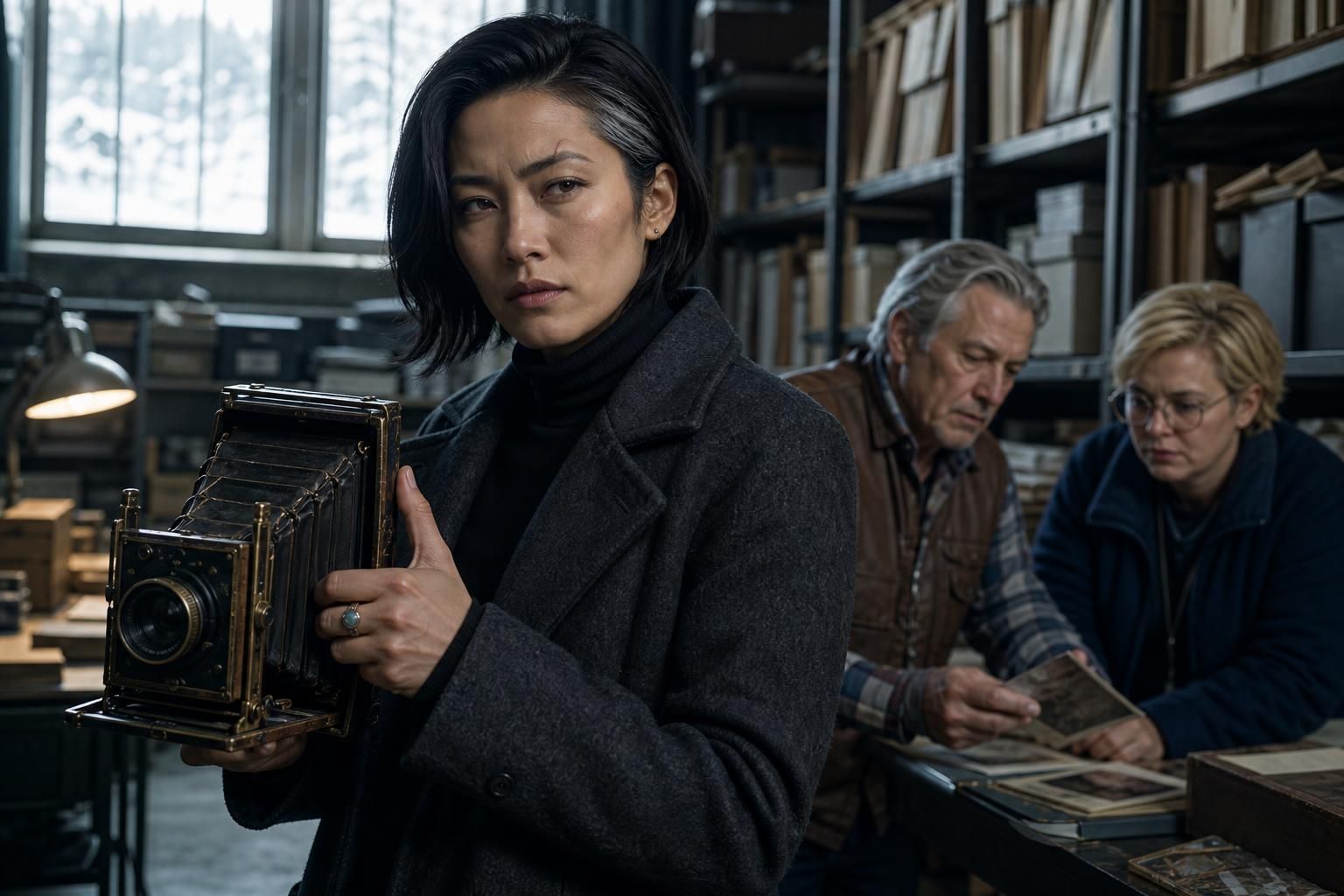
The evidence room smelled of old paper and metal. Snow fell past the high window, silent and steady.
Detective Mara Chen pulled the box from the third shelf. The label read: "Croft, E. – 2004." She had requested it for a routine cold-case review, a disappearance that had never been solved. Nineteen years was a long time to be missing.
She carried the box to a steel table and lifted the lid. Inside were yellowed case files, a handful of undeveloped film canisters, and something else—a camera.
It was old. Brass fittings, cracked brown leather bellows, a folding design she had only seen in museum displays. She lifted it carefully. The viewfinder was clean, and through it she saw a faint image, though no film was loaded. She touched the silver jade ring on her right index finger, a habit when thinking.
"That's weird," said Officer Danica Rowe, the evidence custodian, appearing beside her. "That box has been logged out three times in the past nineteen years. But never by anyone in the department."
Mara looked up. "Three times? By who?"
"Unknown. The log just shows dates. No signature."
Mara opened the camera. Inside, a single undeveloped frame sat in the film holder, as if waiting. She closed it without touching it further.
That afternoon, she drove to the home of Leo Vargas, retired crime-scene photographer and Ellis Croft's former partner. Leo lived in a quiet house near the waterfront, his darkroom in the basement.
He recognized the camera immediately. His face went pale. "That's a Bell & Archival No. 3," he said, his voice low. "It belonged to Ellis. He never went anywhere without it."
"When did you last see it?"
Leo touched his missing left index fingertip, a nervous gesture. "The day he disappeared. We were working a scene at an old studio downtown. He stepped out for a moment and never came back. The camera was gone too."
"Why was it in a cold-case box?"
"I don't know. I never saw it again until now." He wouldn't meet her eyes.
Mara left with more questions than answers. That night, alone in her apartment, she set the camera on her kitchen table. Snow continued to fall outside. She examined it under the lamp, turning it over in her hands. The bellows were cracked on the left side. The brass was tarnished. The viewfinder still showed that faint, ghostly image.
She didn't mean to touch the shutter release. But as she adjusted her grip, her finger brushed the lever.
A soft click.
From the film slot, a developed photograph slid out, dry and finished, as if it had been waiting for that moment.
Mara picked it up. The image was black and white, high contrast, with slightly bleeding edges. It showed a concrete floor, the pattern of old tiles cracked and stained. In the frame, a hand lay palm up, fingers curled. On the index finger was a ring—a silver band with a small jade stone.
Identical to hers.
She looked at her own hand. The ring was still there. The photo showed a different hand, in a different place, but the ring was the same.
Then she noticed the date burned into the bottom corner of the print: tomorrow's date.
Mara stared at the photograph. The floor pattern was not from the police station or any crime scene she knew. But she had seen it before—in Leo Vargas's home, in an old framed photograph on his wall. The floor of the Bell & Archival studio, abandoned for nineteen years.
The cold case was not cold. It was still unfolding.
She touched her ring again, and the camera sat on the table, silent and waiting.
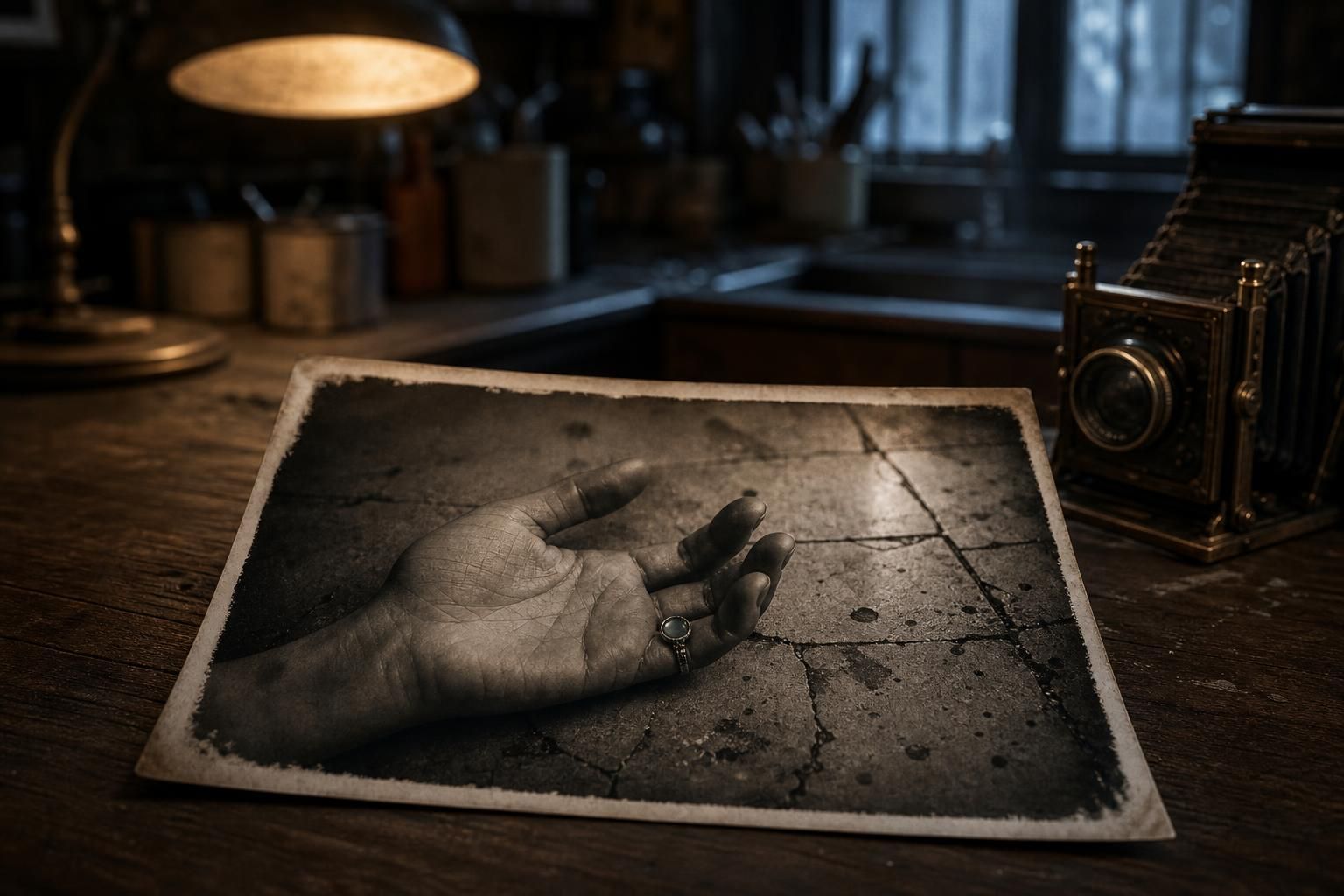
Mara stares at the photograph, recognizing the floor pattern from the old Bell & Archival studio, which has been locked for 19 years.
Part 2: The Developer's Secret
Mara breaks into the abandoned studio and finds a darkroom that has been used recently. The camera produces a second photograph—one that shows her own body.
Wednesday morning. Snow had fallen all night, blanketing the waterfront in white. Mara stood outside the Bell & Archival studio, the photograph from her apartment in her gloved hand. The concrete floor in the image matched the pattern visible through the studio's grimy front window.
Danica Rowe arrived, jangling a set of keys from the evidence room. "The landlord is a property bank. No one's complained about this place in fifteen years." She unlocked the deadbolt with surprising ease. The door groaned open.
Inside, the air was cold and still. Display cases lay shattered. A faded sign reading "Bell & Archival — Fine Photography Since 1922" hung crookedly over a counter. Dust covered everything. But the floor—Mara knelt and touched it. The same hexagonal pattern as the photograph. The same gray concrete, same crack running diagonally from the corner.
"The hand was there," Mara said, pointing to a spot near the back wall. "And the ring."
Danica pulled out a flashlight. "There's a door behind that counter." They pushed through a narrow hallway lined with empty frames. At the end, a steel door with a deadbolt that had been recently oiled. The lock turned without resistance.
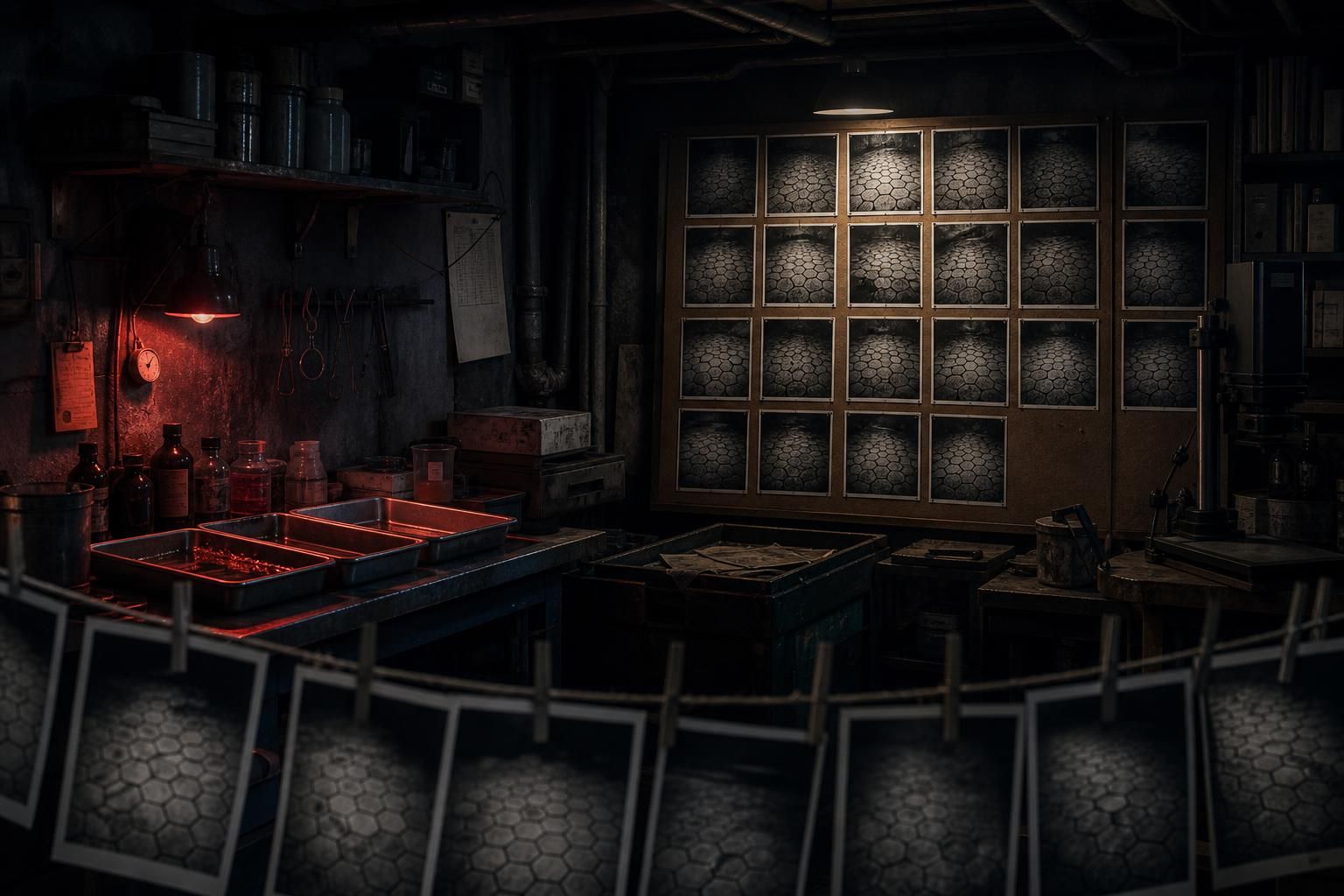
A staircase led down. The air grew warmer, damp. At the bottom, a red safelight glowed.
Mara's breath caught. The darkroom was fully equipped. Trays of chemicals sat on a stainless steel counter, still wet. A clothesline stretched across the room, pinned with strips of photographic paper. And on a corkboard, arranged in a neat grid, were seventeen photographs.
Each one showed the same concrete floor. Same hexagonal pattern. Same crack. But each was taken from a slightly different angle, as if the photographer had circled a point on the floor. And each had a date stamp in the bottom right corner—different dates, spanning the last nineteen years.
The most recent was dated tomorrow.
"These were taken from the same spot," Danica said, her voice hushed. "Like someone's been coming here for years, photographing the same empty floor."
Mara touched the jade ring on her right index finger. The hand in the photograph—the one wearing a ring just like hers—had been lying on that floor. And the photograph was dated tomorrow.
Footsteps sounded on the stairs. Leo Vargas appeared in the doorway, his face pale, a brown leather vest over a plaid shirt. He held a set of keys in his hand with the missing fingertip visible.
"You found it," he said quietly.
"You knew," Mara said. "You knew this darkroom was here."
Leo nodded slowly. "I've been coming here for years. Ever since Ellis vanished. The camera—it only works for someone who believes it. I never believed it. Not really. But I kept coming back, hoping."
He pointed to the contact sheet. "Seventeen photos. Each one taken by someone who saw through the viewfinder and believed. And each time, the camera produced a picture of that floor. But never a body. Until now."
Mara's bag shifted. A soft click. She reached inside and pulled out the folding camera. The bellows had expanded. A developed photograph was sliding out of the slot.
She held it up to the red safelight.
The image was wider than the first. It showed the same concrete floor, the same hexagonal pattern. But now she could see the full scene. A body lay on the floor, face-down, wearing a charcoal wool coat and black turtleneck. The right hand was visible, reaching out. On the index finger, a silver ring with a small jade stone.
Mara's hand. Her coat. Her ring.
"That's me," she said. Her voice was flat, clinical, as if reading a case file. "That's my body."
Leo's face went gray. "Ellis didn't vanish," he said. "He stepped into one of the photographs. He believed so completely that the camera pulled him across. And he never came back."
Mara stared at the photograph. Her own death, dated tomorrow. But the hand was reaching out, not lying still. Reaching toward the camera.
She touched the jade ring. "Then I have to go where he went."
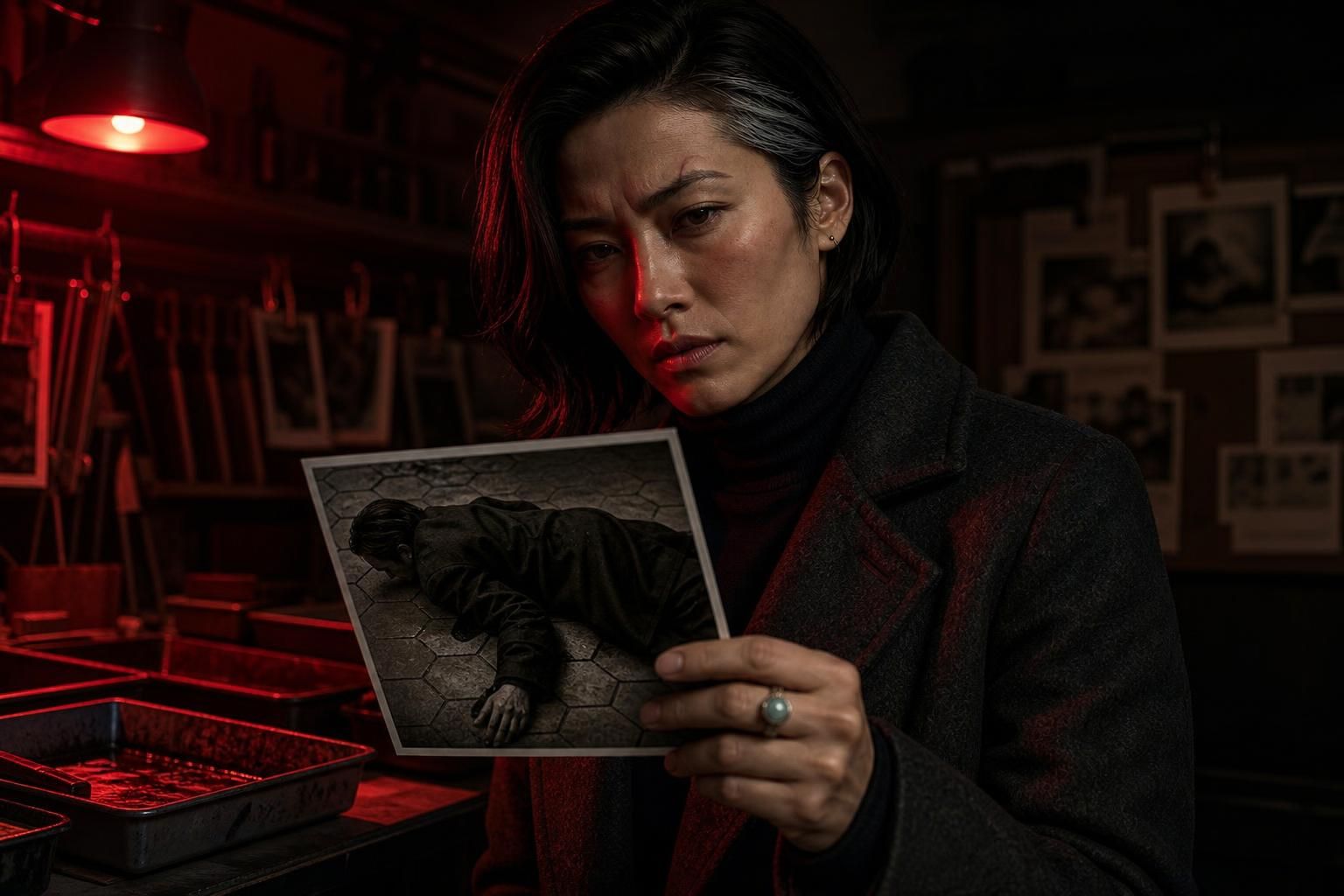
Mara touches her jade ring, looking at the camera, and says: 'Then I have to go where he went.'
Part 3: The Photographer's Side
Mara returns to the studio alone, studies the contact sheet, and finally sees the face behind the camera.
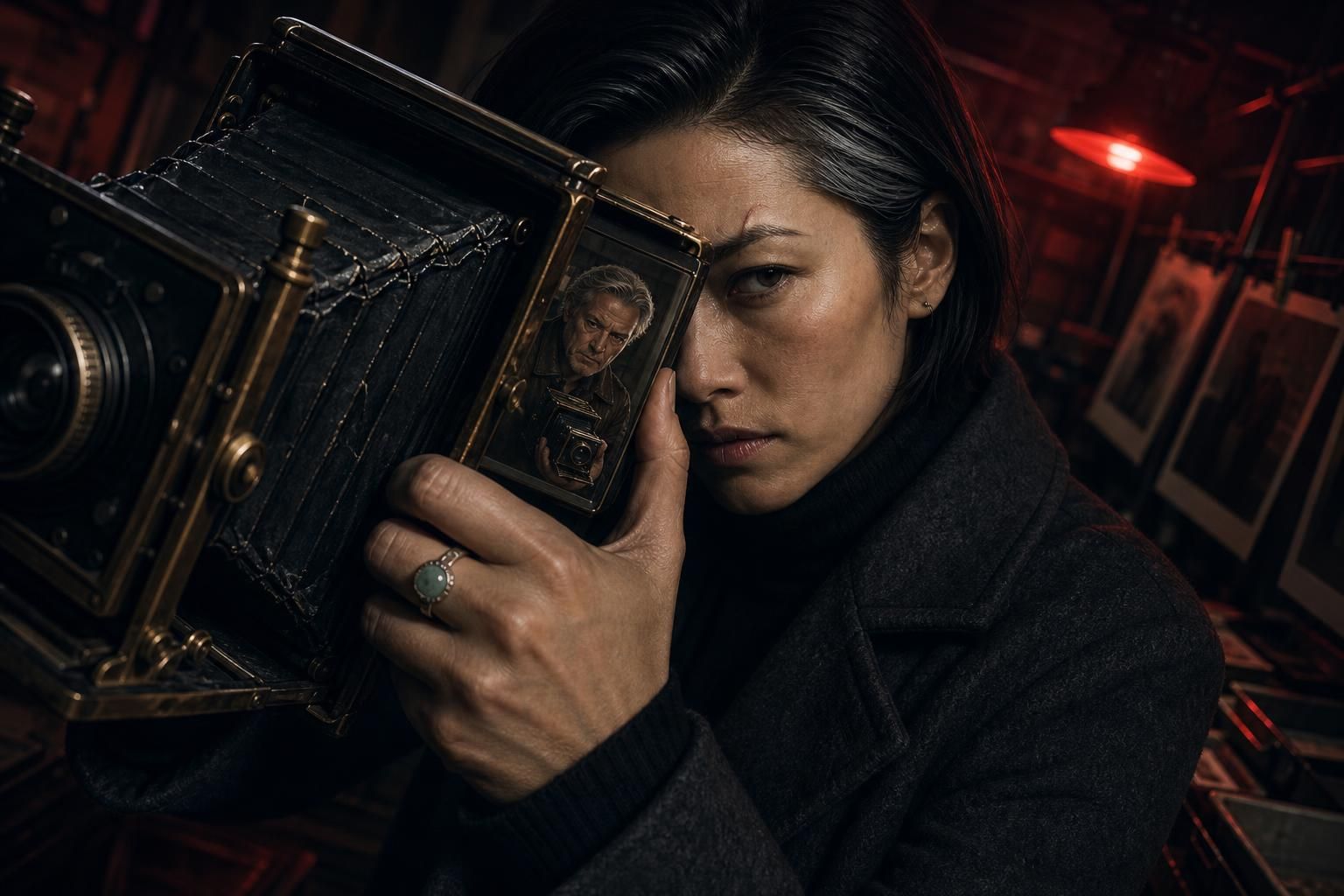
Thursday morning. The snow had stopped, leaving Portland muffled and white. Mara stood in the Bell & Archival darkroom alone. The red safelight cast everything in a deep crimson glow.
She spread the contact sheet across the counter. Seventeen squares. Seventeen photos of the same concrete floor, each with a different date stamp. She studied them in order.
The first was dated March 12, 2004. The floor was clean, empty. The second was April 3, 2004—a shadow fell across the lower left corner. The third was May 1, 2004—the shadow had moved, as if someone was circling. By the twelfth photo, dated January 2005, a faint mark appeared on the concrete. A scrape. By the sixteenth, dated two months ago, a dark stain was visible near the center.
The most recent photo was dated yesterday. The stain was larger.
Mara touched her jade ring. She understood now. Each photo was taken from a slightly different angle, as if the photographer was slowly walking around a body that was never visible—until the stain appeared. The photographer was documenting something that was already there, in another reality.
The camera did not predict. It recorded a parallel present. And in that present, she was already lying on that floor.
She picked up the folding camera. The viewfinder showed a faint image, as always. But now she understood: that image was the other side. The room she was standing in, seen from a different angle. Seen by someone else.
"You see it now."
The voice came from behind her. She spun around.
A man stood in the doorway of the darkroom. He was older—gray hair, deep lines around his eyes. He wore a worn leather jacket and held an identical folding camera. The same brass fittings, the same cracked bellows on the left side.
"Ellis Croft," Mara said.
He nodded. "I've been waiting for someone who could see the pattern. Nineteen years."
Mara looked from Ellis to the camera in her hands. "You've been leaving this in evidence rooms. Pulling people toward the photographs."
"Not people. One person. The one who could understand." He stepped closer. "Every time someone believes the camera, the door opens a little wider. You believed. And now you see."
"The box was logged out three times," Mara said. "That was you. From the other side."
Ellis nodded. "I came back each time to leave the camera where someone would find it. I put it in your cold-case box myself. You were the only one who ever opened it."
The camera in Mara's hands grew warm. She looked through the viewfinder. This time, the image was sharp. She saw herself, sitting in her apartment, looking at the camera. But that was not her reflection. That was her, in the other timeline.
A developed photograph slid out from the camera and landed on the counter. Mara picked it up. It showed her own face, taken from inside the apartment, as if the photographer was standing in her living room.
"That's the third photograph," Ellis said. "It just developed. You can see yourself on the other side now."
"Why?" Mara asked. "Why trap yourself?"
"I didn't trap myself. I found the murder that started all of this." He pointed at the floor. "The man in those photos is Leo Vargas's brother. He was killed here, in 2004. I came through to photograph the scene. But the crossing only works one way. I've been waiting for someone who could solve it."
Mara looked at the photograph in her hands. Her own face, looking back. "Solve it from my side?"
"No. From this side. You have to come through. You have to see the scene in person—the real scene, not a photograph. The evidence is here. The killer's name is in the records. But I can't access them. I'm trapped."
Mara thought of her apartment. Her job. The cold-case files she would never close. Then she thought of Leo's face when he talked about Ellis. The guilt. The hope.
She lifted the camera to her eye.
The viewfinder showed the darkroom, but from a different angle—from the doorway where Ellis stood. She took a step forward.
The world tilted. Sound vanished. Cold air rushed past her face.
She was standing in the same darkroom. But the light was different—dimmer, older. The red safelight flickered. Ellis stood beside her, and for the first time, he smiled.
"Welcome," he said.
Mara looked down. She still held the camera. The jade ring was still on her finger. She had brought it with her.
She turned and looked at the concrete floor. There was a body there now. A man in a brown leather vest, his left hand whole. Leo's brother.
She knelt and examined the scene. This was the evidence she needed. This was the crime she could solve.
On the other side, the original darkroom was empty. The camera sat on the counter, its viewfinder dark. A single developed photograph lay beside it: a close-up of a hand with a silver jade ring, reaching toward the lens. Mara had taken that photo from the parallel side, then left the camera behind.
She was the photographer now.
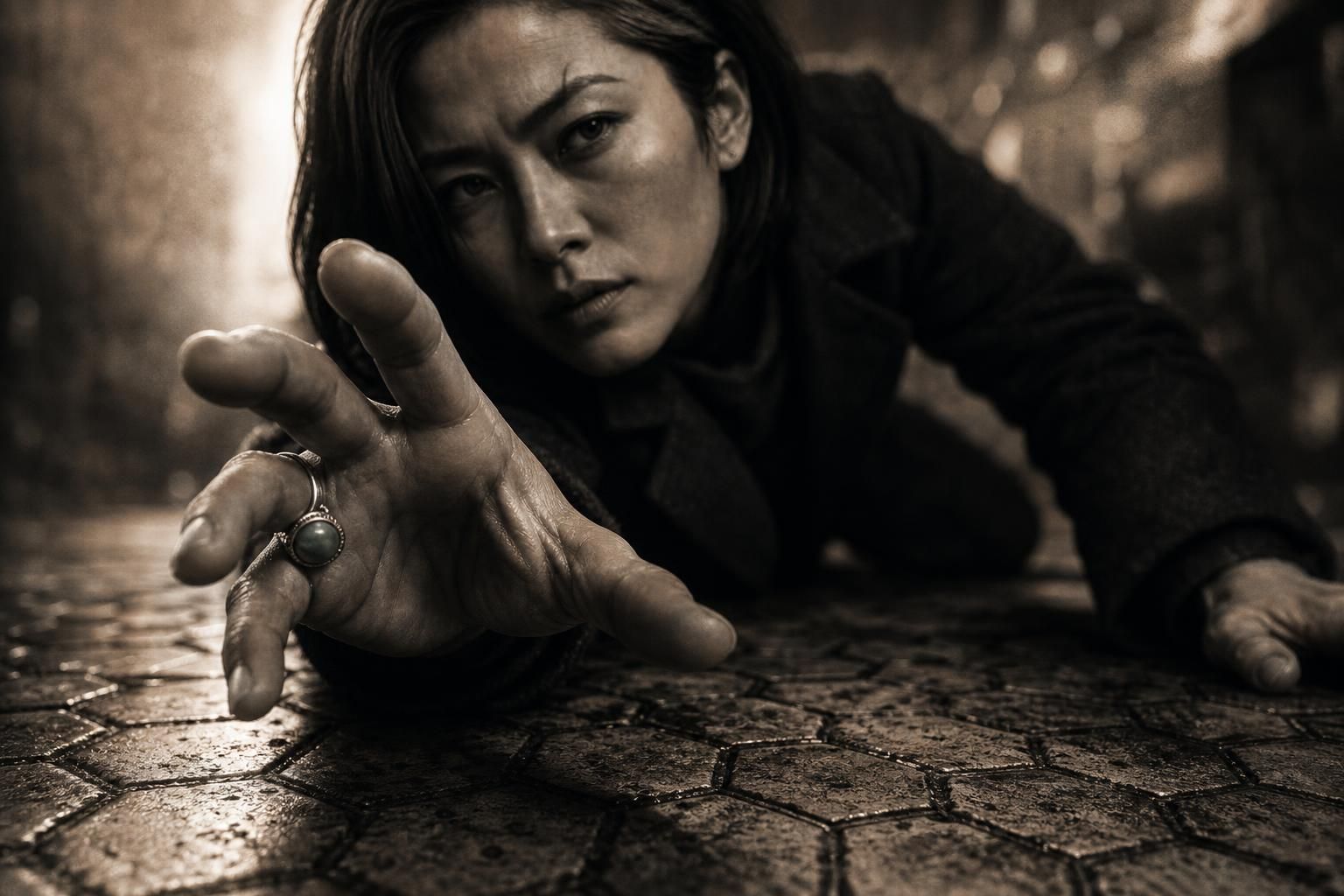
The camera sits on the counter of the empty darkroom, its viewfinder dark. A single developed photograph lies beside it: a close-up of a hand with a jade ring, reaching toward the camera. Mara had taken that photo from the parallel side, then left the camera behind. She was the photographer now.

