

Horror Fiction Serial
The Last Candle at Kettleburn
A lighthouse keeper discovers an old wax seal on a forgotten logbook—and a light that should not still be burning.
On a lonely coastal rock, a lighthouse keeper finds a logbook sealed with wax—and a flame that has been burning for a century without fuel. Some lights should never be relit.
This is a fictional story. All characters are adults. Any resemblance to real persons, places, or events is coincidental.
Part 1: The Wax Seal
The supply boat departs. Maren begins her watch. Then she finds the locked drawer.
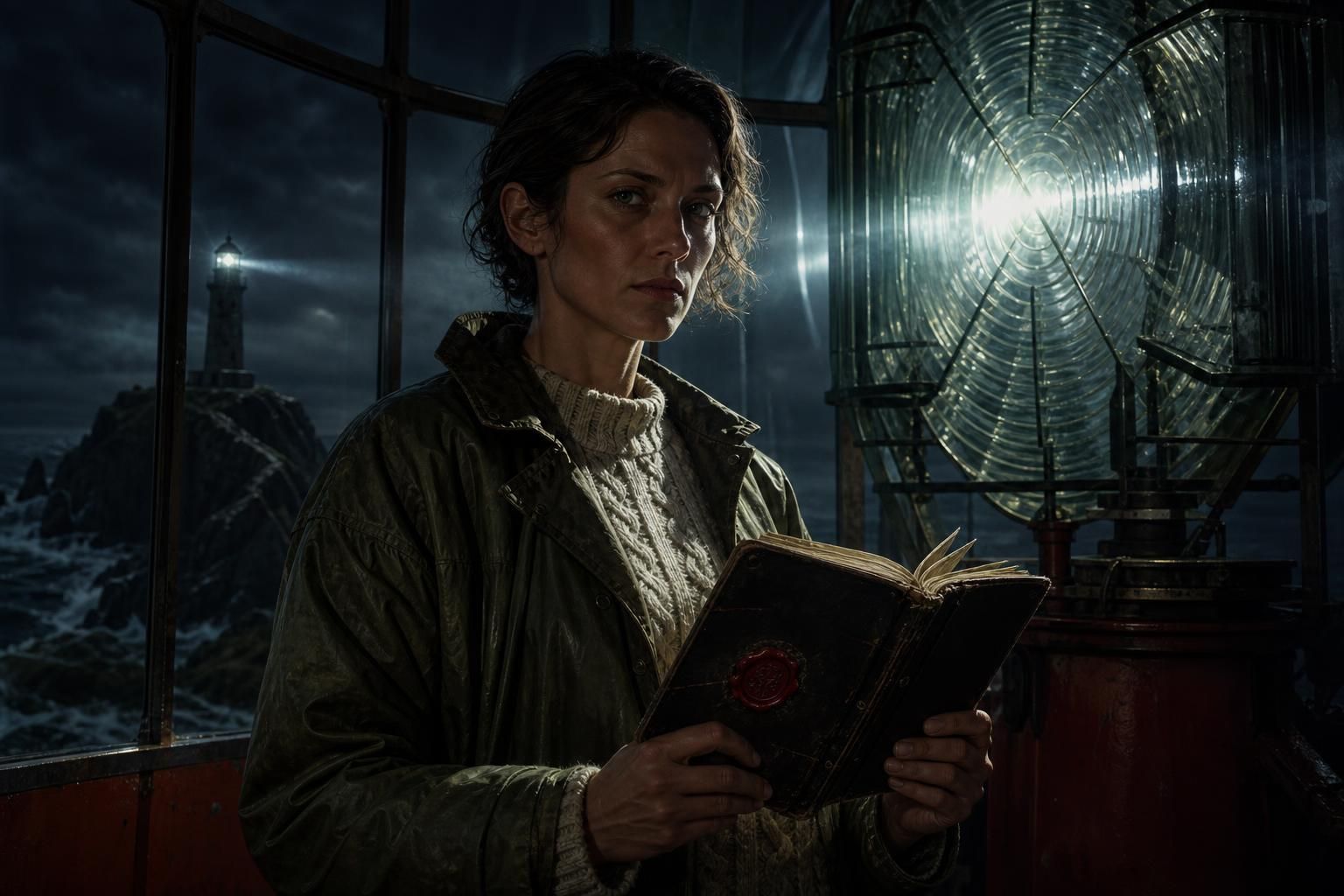
The supply boat’s engine faded into the fog before Maren Orbach had hauled her second duffel up the spiral stairs. Kettleburn Lighthouse rose from a slab of granite like a bone through old skin, and the autumn sea around it was the color of cold iron. She was alone.
Ellery Foss had briefed her by radio the night before—his voice crackling with static, his warnings familiar from every other rotation she’d done. Watch the damp in the lantern room. Keep the lens cloth dry. Check the fuel line every evening. He’d said nothing about the drawer.
She found it on the second day. Tucked beneath the logbook shelf in the watch room, a shallow oak drawer painted shut, its brass pull gummed with decades of salt and neglect. She had to wedge a chisel under the lip and hammer it with the heel of her palm. The wood splintered. Inside lay a single logbook bound in cracked black leather, its pages yellowed, its cover sealed with a disk of red wax.
The seal was intact. Embossed with an anchor and a flame. No one had opened this book since the day it was closed.
Maren broke the wax with her thumb. The first entries were routine—weather, wind, lamp checks—in a tidy cursive hand dated 1911. The final entry was October 31. The handwriting changed halfway through the page, becoming jagged, pressed so hard the nib had torn the paper.
"The light does not go out. I have tried everything. It is hungry."
She read the line three times. The lamp was not electric, she realized. There was no fuel tank in the lantern room. She looked up from the logbook.
The beam was burning.
A steady, blue-white flame hovered above the burner assembly, casting a cold radiance through the Fresnel lens. The reservoir beneath it was empty. No wires. No fuel line. Just the flame, burning without source, without reason.
Maren’s breath caught. She set down the logbook. She walked to the lamp, her boots loud on the iron floor. She cupped her hand beside the flame and felt no heat—only a deep, sucking cold, as if the light was drawing warmth from the air around it.
She blew it out.
The lantern room went black. The silence was absolute, thick as wool.
Then a whisper came from the lens, soft as a breath on glass: "Don't."
The flame relit itself. Blue-white, unwavering. It had never gone out at all.
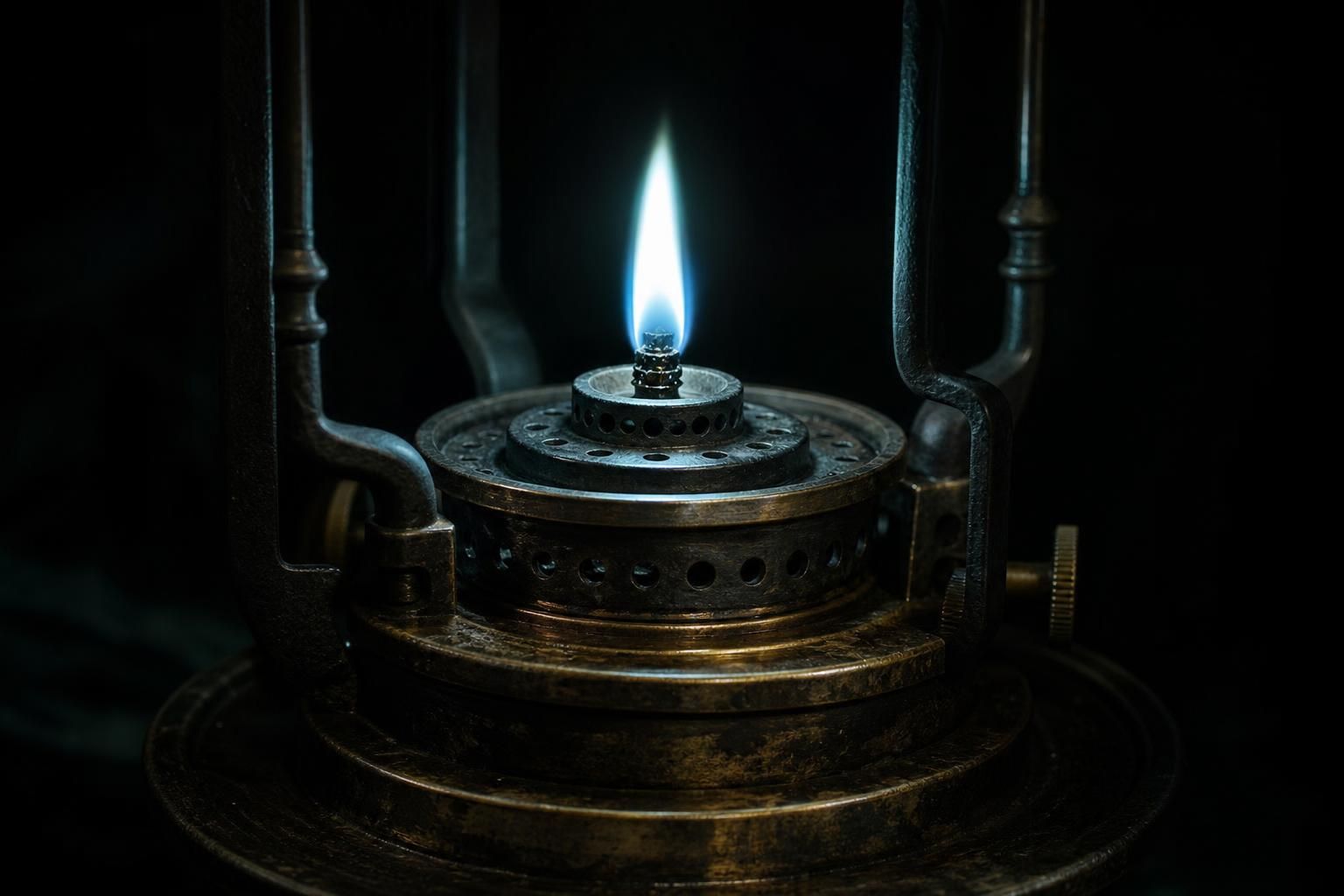
She blows out the lamp. The flame dies. Then, a whisper from the lens: 'Don't.' The lamp relights itself.
Part 2: The Hungry Light
A flame that cannot die. A voice that already knows her.
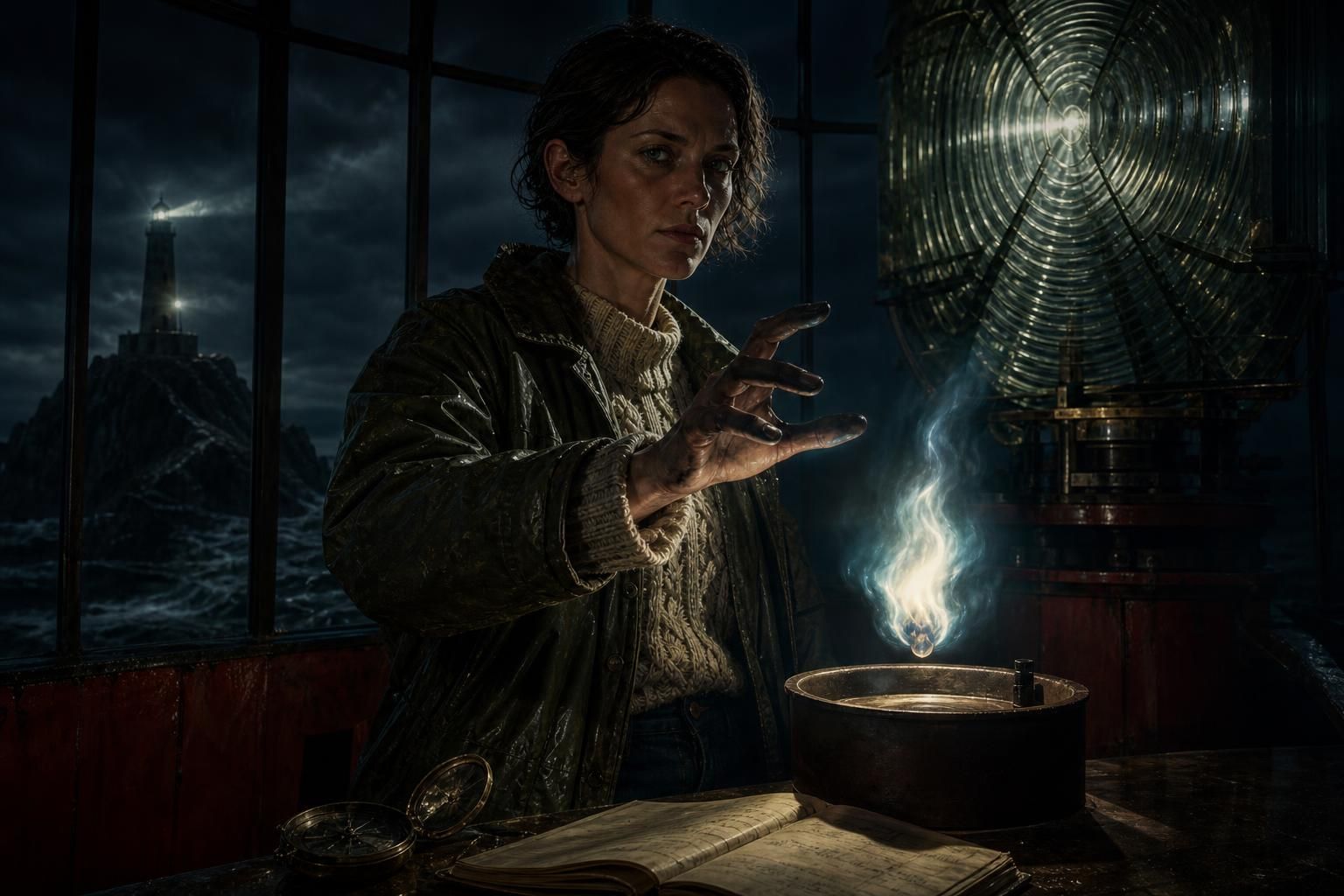
Maren didn't sleep that first night. She sat at the desk in the lantern room, her father's compass cold against her palm, watching the blue-white flame hover above the empty reservoir. The whisper had faded, but the lamp burned steadily, as if it had always been lit.
At dawn she radioed Ellery. His voice crackled through the static, warm and unconcerned. "Kettleburn treating you well?"
"The lamp," she said. "When was the electrical system installed?"
A pause. "Electrical? It's always been electric, far as I know. Why?"
She looked at the flame—no wires, no fuel line, nothing but light feeding on air. "Just checking."
Ellery told her the old stories then: the keeper who vanished in 1911, the rumors of a ghost light that sailors claimed could speak. "Folklore," he said with a chuckle. "You know how these old lighthouses get."
Maren didn't correct him. She hung up the radio and began her first experiment.
She tried sand. The flame swallowed it, flickered, and returned. Water hissed into steam, but the light did not dim. A metal cover dropped over the burner—heat bled through the seams, and when she lifted it, the flame was waiting, patient, unchanged.
By midday her hands trembled. She set down the cover and noticed the compass on the desk. The needle no longer pointed north. It pointed at the lamp, steady and unerring, as if the flame had become its true north.
"That's not possible," she whispered.
The flame flickered once, almost in acknowledgment.
She moved the compass across the room. The needle followed her, always aimed at the lamp. She shoved it into a drawer and latched it shut. When she opened the drawer an hour later, the compass lay on top of the logbook, its needle still fixed on the light.
That night exhaustion won. She fell asleep in the chair, her head on the desk, the logbook open beneath her cheek.
She dreamed of the sea. A cold, bottomless green, and beneath the waves a voice that spoke in her own mother's cadence, reciting a lullaby Maren had not heard since childhood. The words appeared in the water, written in ink that bled like smoke—the same slanted hand from the logbook. *Sleep, little one. The light will keep you.*
She woke gasping.
The lantern room was dark except for the flame. Her hand lay on the desk, palm up. Black soot coated her fingers, the same fine ash that had filled the logbook's pages. She turned her hand over. The soot was embedded in her skin, as if she had reached into the fire.
And on the logbook, on a page she had never touched, a single line in her own handwriting:
*I am still here.*
The date beneath it: October 31, 1911.
Maren stared at the words, and the flame in the lamp burned brighter, casting her shadow huge on the curved wall. From somewhere inside the beam, the voice returned—softer now, almost tender.
"I know your name, Maren."
She looked at the compass on the desk. The needle didn't waver. It pointed at the light. It had always pointed at the light.
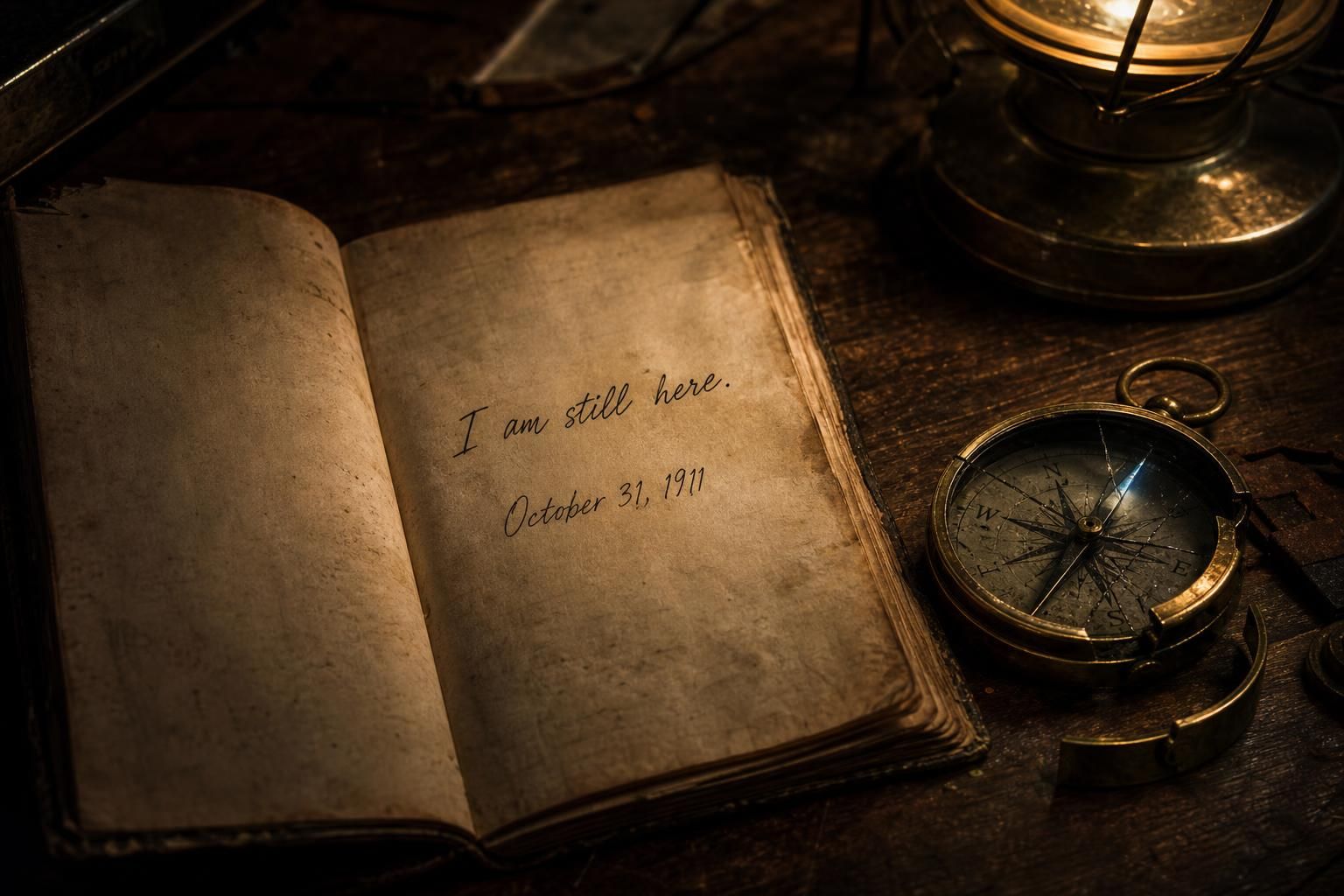
She wakes to find her hand blackened with soot, and on the logbook's next empty page, a line in her own handwriting: 'I am still here.'
Part 3: The Voice Within the Beam
The keeper's logbook is writing itself. And the flame is learning how to speak.
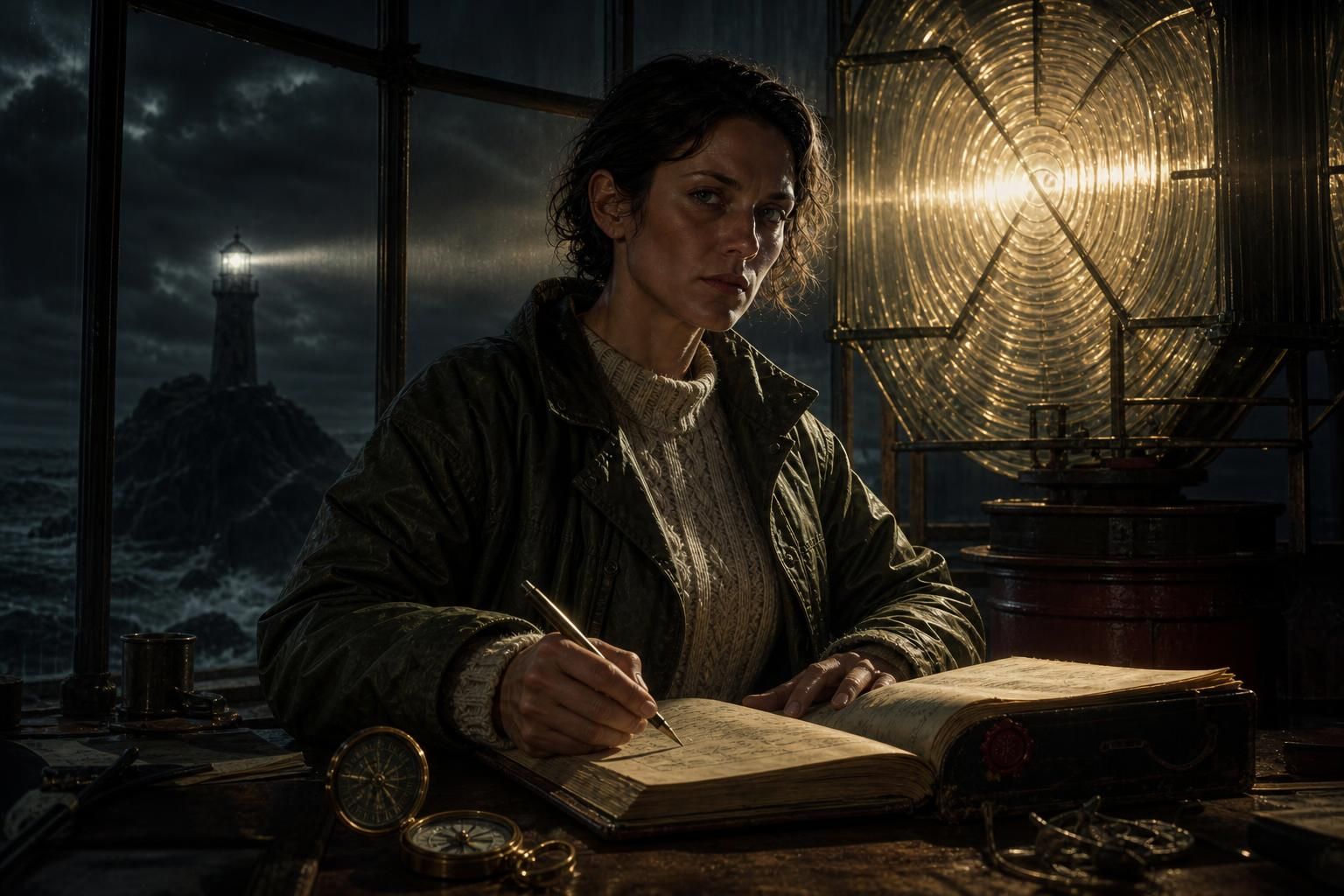
The storm came from nowhere. Maren stood at the lantern room window, watching the horizon swallow itself. No radio. No Ellery. The supply boat would not come.
She had read the logbook cover to cover—or tried to. The entries shifted as she turned the pages. What had been a single keeper's neat copperplate in 1911 now bled into her own handwriting, her own observations. She read: "The lamp relit itself at 0322. No fuel source." That was her entry. But the ink was brown and cracked, as if written a hundred years ago.
The flame flickered. A shape moved inside it—not a reflection, but a form. Shoulders. A head. It turned toward her.
"You've been reading," the voice said. It came from the beam itself, from the air around the lens, from the inside of her skull. Maren's hands shook, but she did not step back.
"What are you?" she whispered.
"I am what remains. The last keeper who could not leave." The flame pulsed, and the light dimmed to a soft amber. "I offered him the same bargain I offer you. Keep the light burning, and the lighthouse will never need another keeper. You will never need to leave. No more boats. No more loneliness."
"And if I refuse?"
The beam swept the sea. In the darkness beyond the glass, Maren saw waves taller than the tower. "Then you will vanish into the water as he did. But you will not die. You will become the fuel."
Maren grabbed the logbook. If the flame fed on attention, on memory, she would starve it. She tore a page free. The flame leaped from the burner and struck her hand—not with heat, but with cold, a deep bone-cold that spread up her arm. The pain was not hers. It was old, borrowed, the remembered ache of a man who had burned alive inside a lantern.
She dropped the book. The flame retreated. The page she had torn was whole again, lying on the desk, the handwriting now reading: "October 31, 1911. I have tried everything. It is hungry."
Maren looked at her hand. No blisters. But her father's compass, which she always carried, now pointed at her own chest.
She understood. The flame did not want her to destroy the logbook. The logbook was the record of its birth. To destroy it would be to unmake the flame—and unmake her, because she was already written in it.
She sat down at the desk. The lamp cast her shadow on the curved wall of the lantern room—a giant, still shape. She picked up the pen. The nib touched the page.
And she began to write.
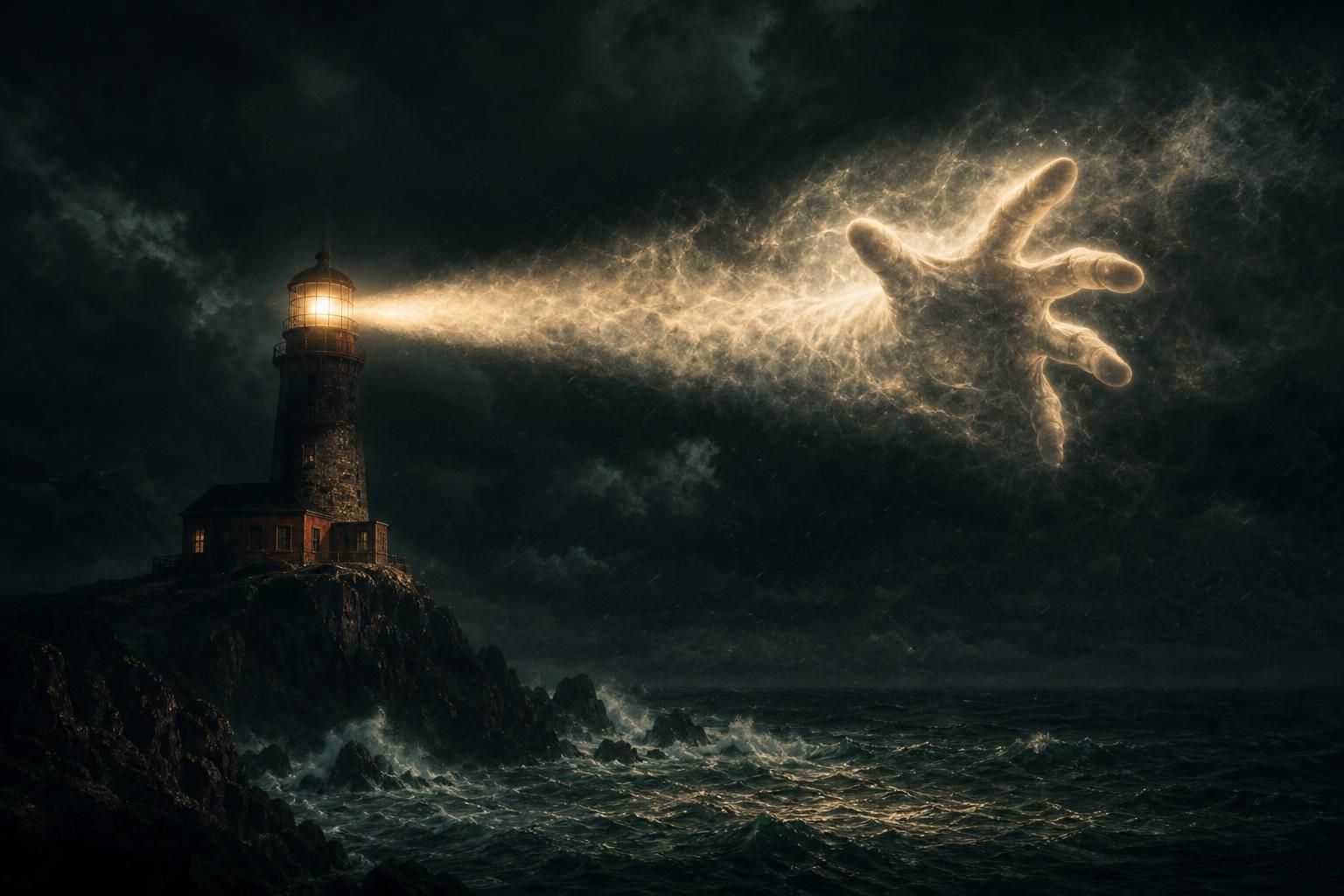
She sets down her compass, picks up the pen, and writes in the logbook: 'October 31, 1911. The light does not go out. I have tried everything. It is hungry.' The flame in the lamp dims to a human warmth. She looks at her reflection in the lens and sees the face of the vanished keeper—her own face, a century younger, wearing his clothes.

