

Mystery Serial
The Cartographer's Last Latitude
A missing mapmaker left behind a single impossible clue: a star that should not exist.
When an archivist finds a dead cartographer's star chart showing a star that astronomy says isn't there, she follows the coordinates into a conspiracy of silence.
This is a fictional story. All characters are adults. Any resemblance to real persons, places, or events is coincidental.
Part 1: The Red Dot
A missing cartographer left behind a single impossible clue: a star that should not exist.
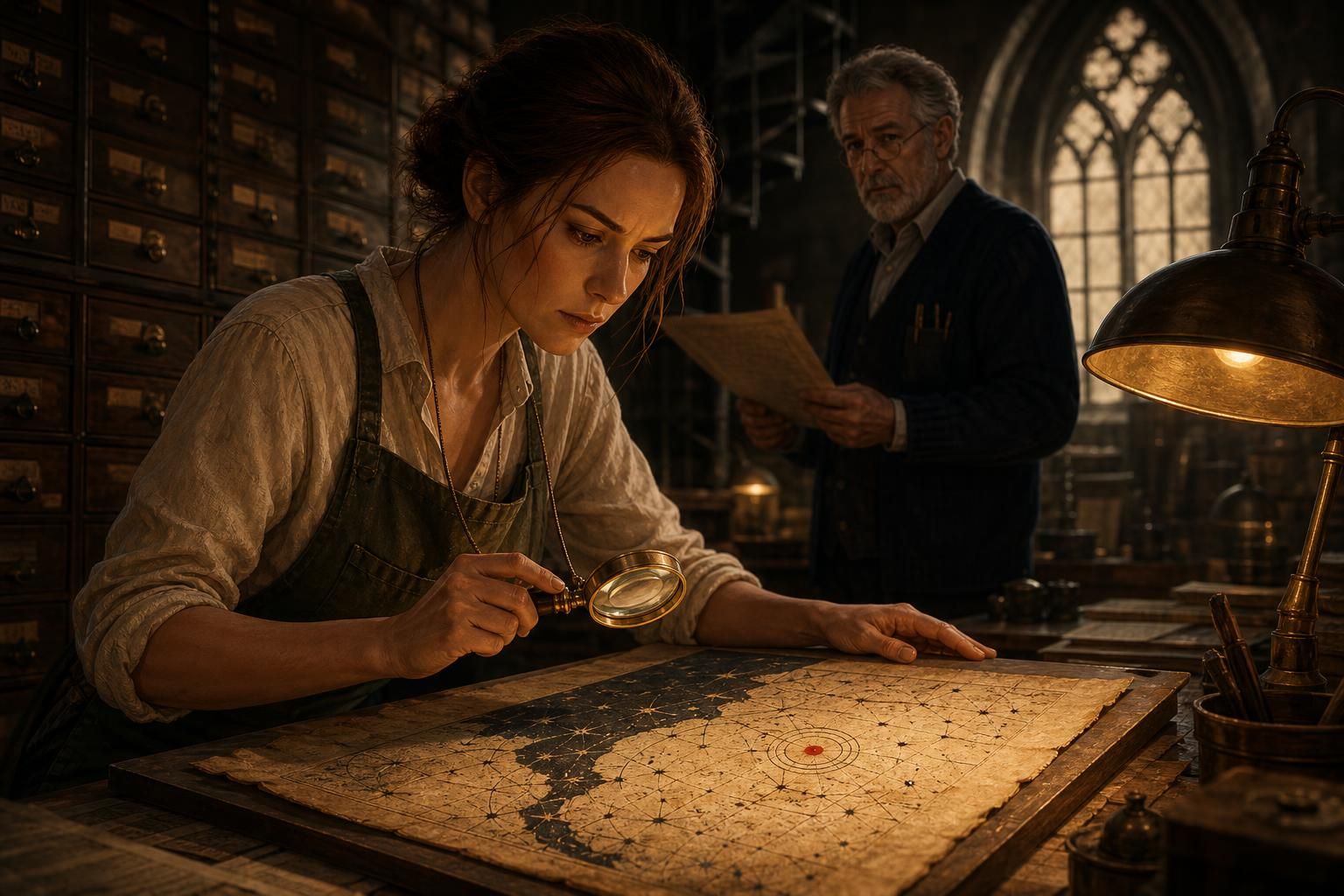
The Navarro Map Archive occupied the nave of a deconsecrated chapel in Salamanca, its vaulted ceiling still painted with faded cherubs who now watched over filing cabinets instead of pews. Elara Voss preferred it this way—the silence, the dust motes performing their slow ballet in the amber light of her desk lamp.
She had been working on the Isabel Navarro donation for three days. The family had sent a trunk of materials from the 1980s, mostly field notes and topographical surveys, all bearing the distinctive cramped handwriting of the cartographer who had disappeared in 1985. Today's task was a star chart—a hand-drawn celestial map on heavy paper, its edges crumbling from poor storage.
Elara slid the sheet onto her restoration board, the brass loupe swinging from its cord as she leaned forward. She worked methodically, first assessing the damage with a gentle brush to remove surface grit. The chart showed the night sky over the Sierra de Gredos, dated November 1984. Constellations were rendered in fine black ink, their Latin names inscribed in elegant script. A meticulous piece of work.
Then she saw it.
A single red dot. Not part of the original ink—added later, in what looked like fountain pen. It sat at a set of coordinates she didn't recognize immediately, far from any plotted star. And around it, concentric circles, drawn and redrawn until the paper had worn thin at the center, nearly translucent. Whoever had made this mark had returned to it obsessively, pressing harder each time, as if trying to will the dot into existence.
Elara reached for the archive's star catalog—a modern digital atlas on her tablet. She input the coordinates. Nothing. She widened the search radius. Nothing. The dot corresponded to empty space. A void where no star, planet, or asteroid had ever been recorded.
She checked the date again. November 1984. Isabel Navarro had been alive then. She had been charting the sky from a remote field station. And she had marked something that astronomy insisted did not exist.
Elara carried the chart to Hugo Castellón's office. The retired astronomer looked up from his desk, pen still in hand, his silver hair catching the window light. She explained what she had found, watching his face for a reaction. He studied the chart through his wire-rimmed glasses, turning it slowly.
"An error," he said finally. His voice was calm, but his thumb rested exactly on the red dot—a deliberate, almost protective gesture. "Field workers sometimes made mistakes. Or perhaps it's a reference mark for something else."
"Then why circle it so many times?"
Hugo's hand stilled. For a fraction of a second, something flickered behind his eyes—a memory, a warning. Then he smiled, too easily. "Obsessive personalities, cartographers. You know that."
He handed the chart back. The moment was gone. But Elara had seen that hesitation, that fraction of a second where he had decided not to tell her something.
She waited until the archive closed, until Hugo's footsteps faded down the iron spiral staircase and the heavy door clicked shut. Then she took the master key from its hook behind her desk and walked to the restricted shelf—a section of the archive that had been Isabel's personal collection, sealed by the family until 2025.
Elara had never opened it before. Now she slid the key into the lock and pulled out a leather-bound logbook. The pages were brittle, the ink faded. She turned to the last entry, dated two weeks before Isabel Navarro vanished.
They will tell you it isn't there, the handwriting read, the script uneven, urgent. But I saw it. I charted it.
Elara's breath caught. She looked at the red dot on the star chart, still lying on her desk. The paper was nearly transparent at its center, worn through by a dead woman's insistence.
Outside, the chapel windows had gone dark. The only light in the archive was her desk lamp, casting a warm halo over the impossible star.
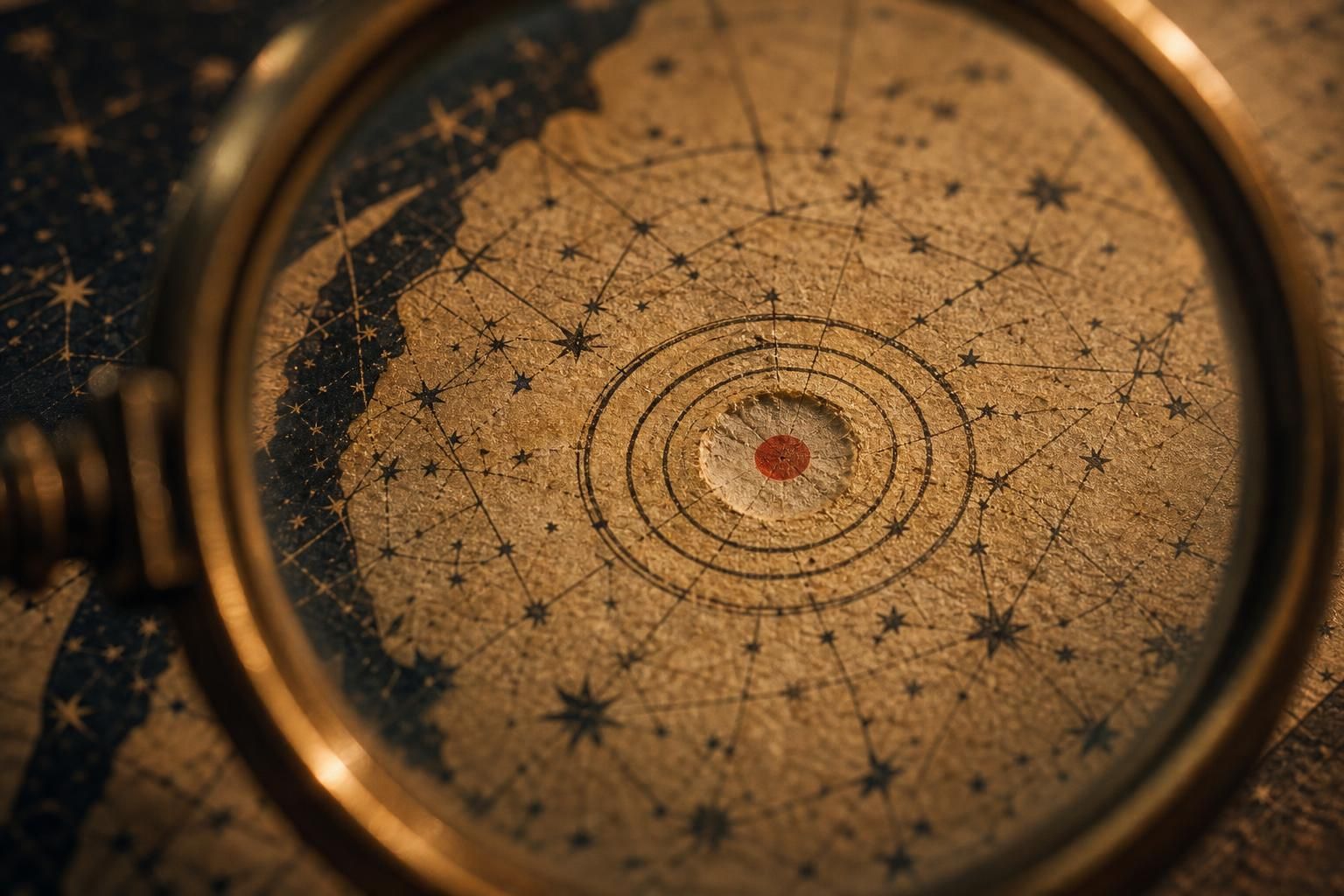
Elara, alone in the archive after closing, pulls Isabel Navarro's old logbook from a restricted shelf. The last entry says: 'They will tell you it isn't there. But I saw it. I charted it.'
Part 2: The Photograph
A sealed envelope holds a light that should not exist—and a warning from the past.
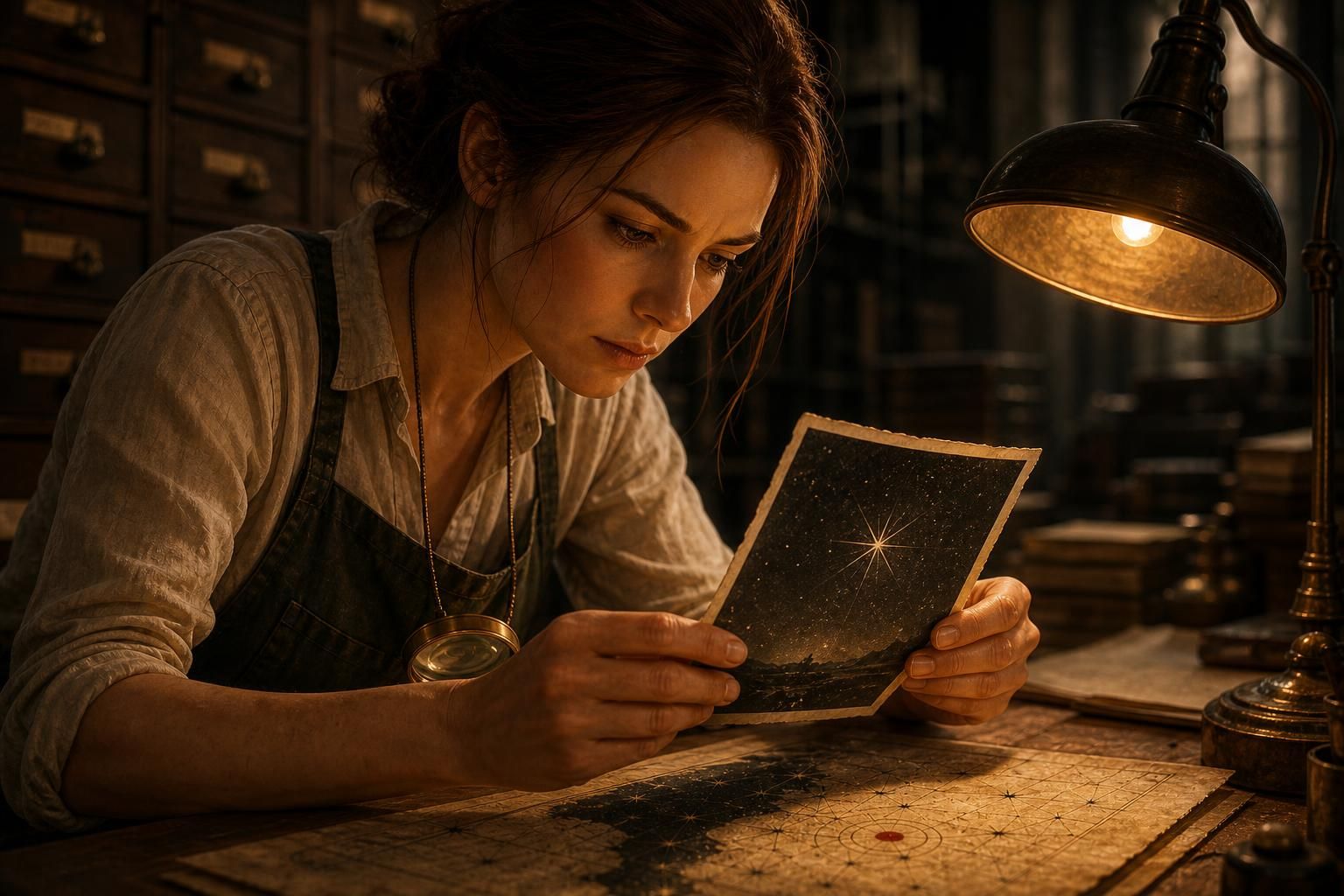
Elara read the final entry three times. The ink was dark, the pressure heavy—Isabel had pressed the pen so hard it had scored the paper. 'They will tell you it isn't there. But I saw it. I charted it.'
She closed the logbook and let her fingers rest on the cracked leather cover. The rest of the entries were erratic, some spanning pages of technical notes, others mere fragments: 'The facility is off the main road. No sign. No name. I followed the fence line for three kilometers before I found the gap.'
Elara glanced at the clock: half past nine. The archive's overhead lights had long since switched to their automatic dimmer, leaving her island of illumination around the desk lamp. The shadows between the tall map cabinets seemed deeper than they had an hour ago.
She turned the page again. The final ten leaves were blank. But as she held the logbook at an angle, she caught the faint ghost of an impression on the last endpaper—a ridge left by something pressed inside. She slipped her fingernail under the edge and peeled up the paper's corner. There was a pocket, sealed with a thin strip of dried glue. Inside: a cream-colored envelope, unmarked.
Elara's breath caught. She slid it out. The flap was sealed with a dried red wax circle—no emblem, no initial. She broke the wax with her thumb and pulled out a single photograph: a black-and-white image of the night sky. A landscape of stars, a jagged mountain ridge at the bottom. But near the top, off-center, was a sharp geometric point of light—angular, almost crystalline, nothing like the diffuse glow of a planet or the soft disc of a star. It looked like a tiny cut diamond fixed in the darkness.
On the back, in the same hand as the logbook: 'Gredos Mis., 3 Nov 84, 23:14. They said it was a weather balloon. I know what I saw.'
Elara's hands trembled slightly. She set the photograph flat on the desk and examined it through her loupe. The light was too sharp, too symmetrical. It had edges.
A floorboard creaked behind her. She spun in her chair. Hugo stood at the entrance to the reading room, silhouetted by the dim hallway light. He hadn't made a sound until that single step.
'I thought you'd have left by now,' he said softly.
Elara didn't hide the photograph. She held it up. 'She took this. At a military facility in the mountains.'
Hugo walked closer. When he reached the desk, he looked at the image for a long moment, then removed his glasses and polished them on his cardigan sleeve. 'Isabel was my graduate student,' he said quietly. 'Before she disappeared. I never told anyone that. I thought if I kept quiet, I'd be safe.'
'Safe from what?' Elara asked.
He put his glasses back on and met her eyes. 'Those coordinates you found—they point to a decommissioned radar station. But it was never a weather balloon. It was a satellite that wasn't supposed to exist. She found the records. She charted it. And then she vanished.'
He reached into his pocket and held out a small brass key. 'If you're going to follow this, you need to know what she was running from. There's a safe in the basement. I've kept it locked for thirty years.'
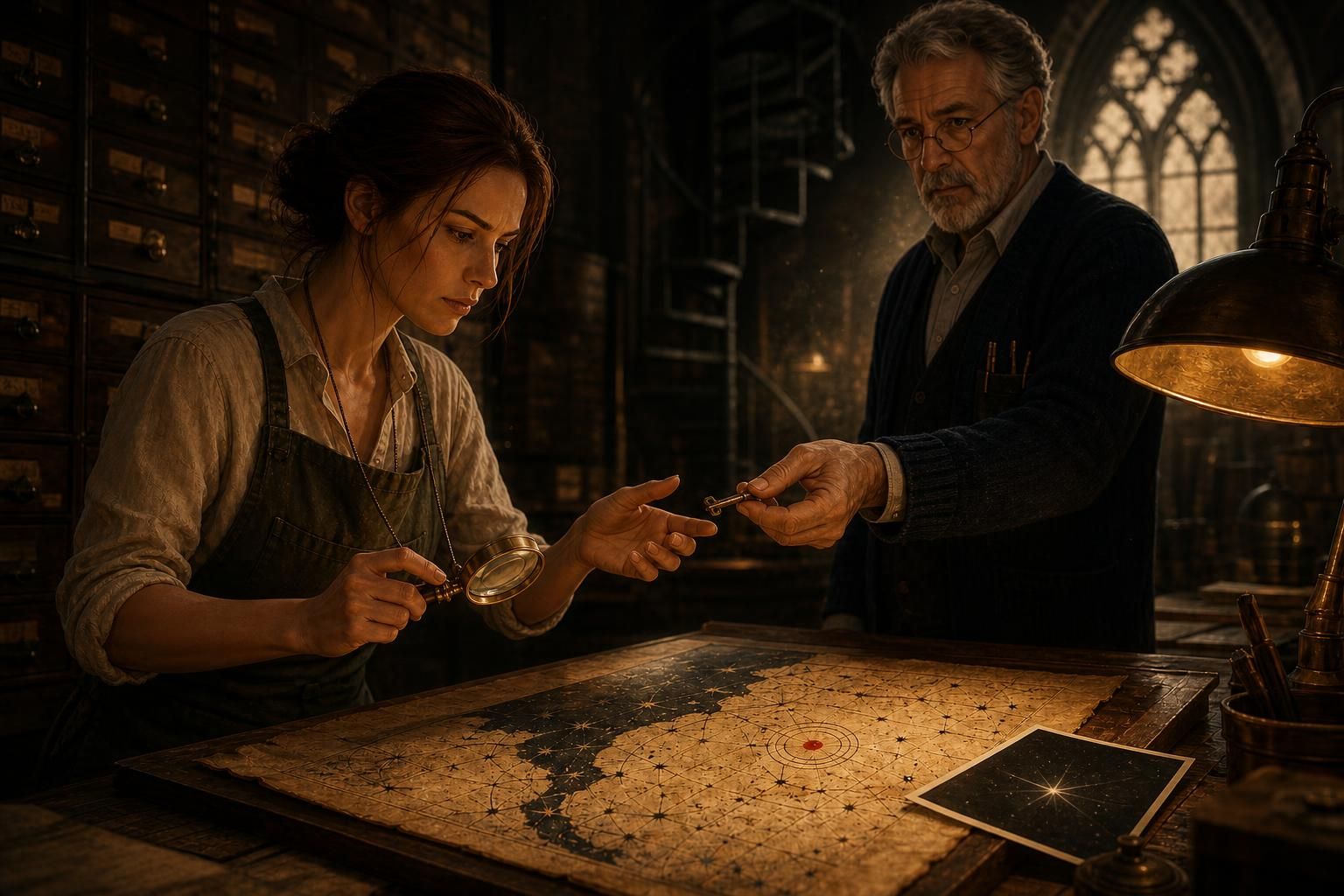
Elara takes the brass key from Hugo's hand. The weight of it is cold and solid. She looks from the key to the photograph—to the impossible star—and feels the archive settle around her like a held breath.
Part 3: The Erased Coordinate
The safe holds a secret that was never meant to see the light.
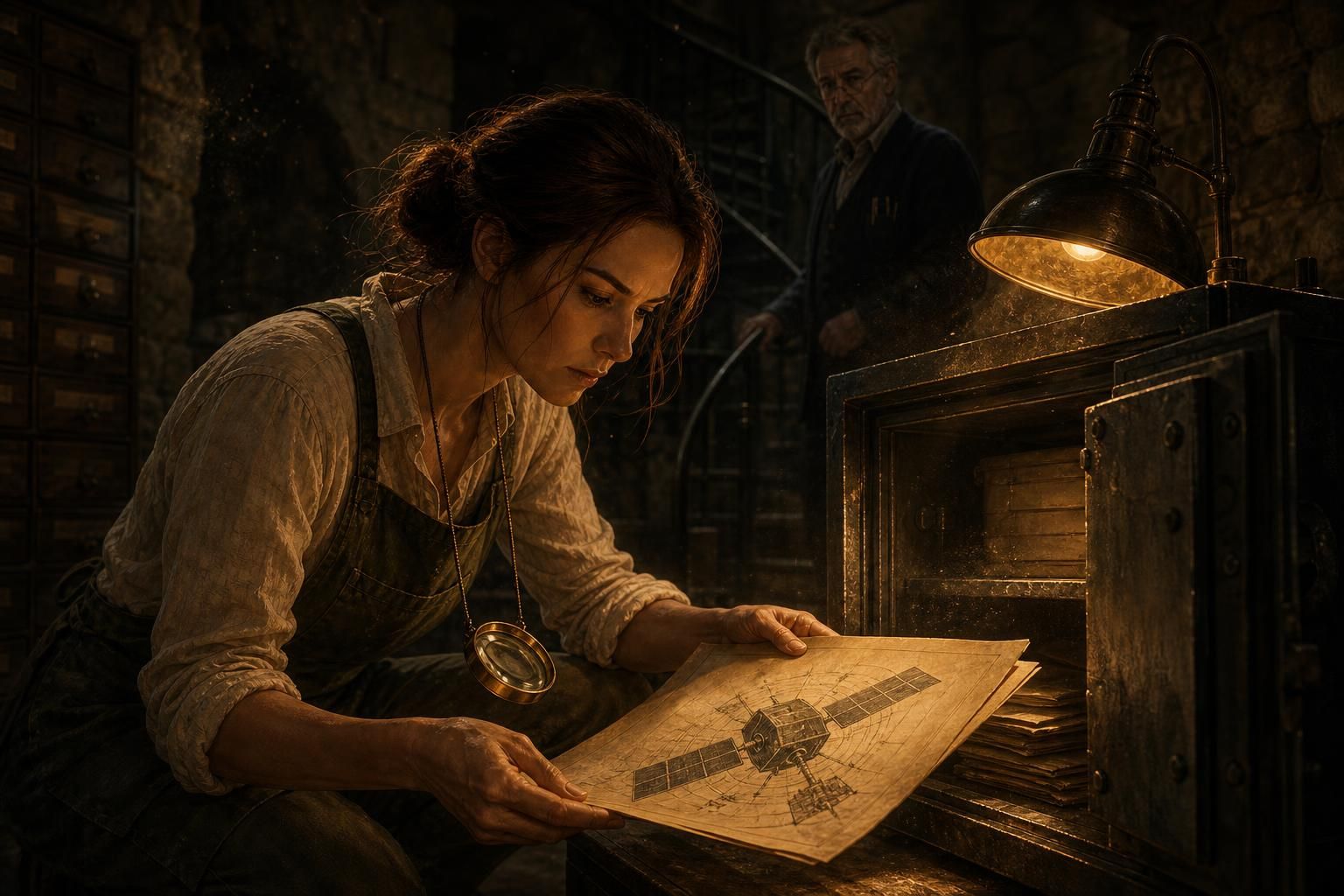
The basement stairs groaned under Elara's weight. Each step sent a cold draft upward, carrying the smell of old iron and forgotten paper. The brass key in her palm was still warm from Hugo's hand, but the air here was damp and chill.
She reached the bottom. A single bulb swayed overhead, casting long shadows across a row of locked cabinets. The safe stood against the far wall—a squat, grey box, its dial door bearing a brass plate engraved with the archive's initials. Elara knelt. The key slid into the lock with a soft click that seemed too loud in the silence.
The door swung open. Inside lay a single manila folder, its edges yellowed. She lifted it out, careful not to disturb the dust that had settled undisturbed for decades. Setting it on the cold floor, she opened the cover.
A classified military report. Dated 1984. The header read: PROJECT VEGA—CONFIDENTIAL—EYES ONLY.
Her breath caught. She turned the pages slowly. Technical diagrams of a satellite—angular, odd, not like any she'd seen in astronomy textbooks. A failed test. A malfunction that caused the satellite to broadcast a signal that could be mistaken for a star. The entire project had been buried. The satellite was left in orbit, officially deleted from all records.
And there, in the margin of the last page, a handwritten note in the same ink as Isabel's logbook: "I saw it. I charted it. They can't erase what I've drawn."
Elara's hands trembled. She read the name of the whistleblower who had contacted Isabel: Captain Mateo Rivas, stationed at the radar facility in the Gredos Mountains. A phone number was scribbled below, faded to near invisibility.
She pulled out her phone. The number was still legible. She dialed.
The line rang three times, then clicked. A recorded voice: "The number you have reached is no longer in service."
She ended the call, staring at the papers. The answer was here, but it was cold. Dead. Just like Isabel.
Then her phone vibrated. A new email notification. The sender was unknown. Subject line: "RE: Your recent inquiry."
She opened it. A single image loaded: a black-and-white photograph of a star—no, the same angular light from Isabel's picture—with a caption in stark, sans-serif type: "STOP CHARTING."
Elara's blood turned to ice. She looked around the empty basement. The shadows seemed deeper now. The single bulb flickered once.
She closed the folder, replaced it in the safe, and locked it. But she knew: she could not go back. She had seen what should not exist, and now someone had seen her.
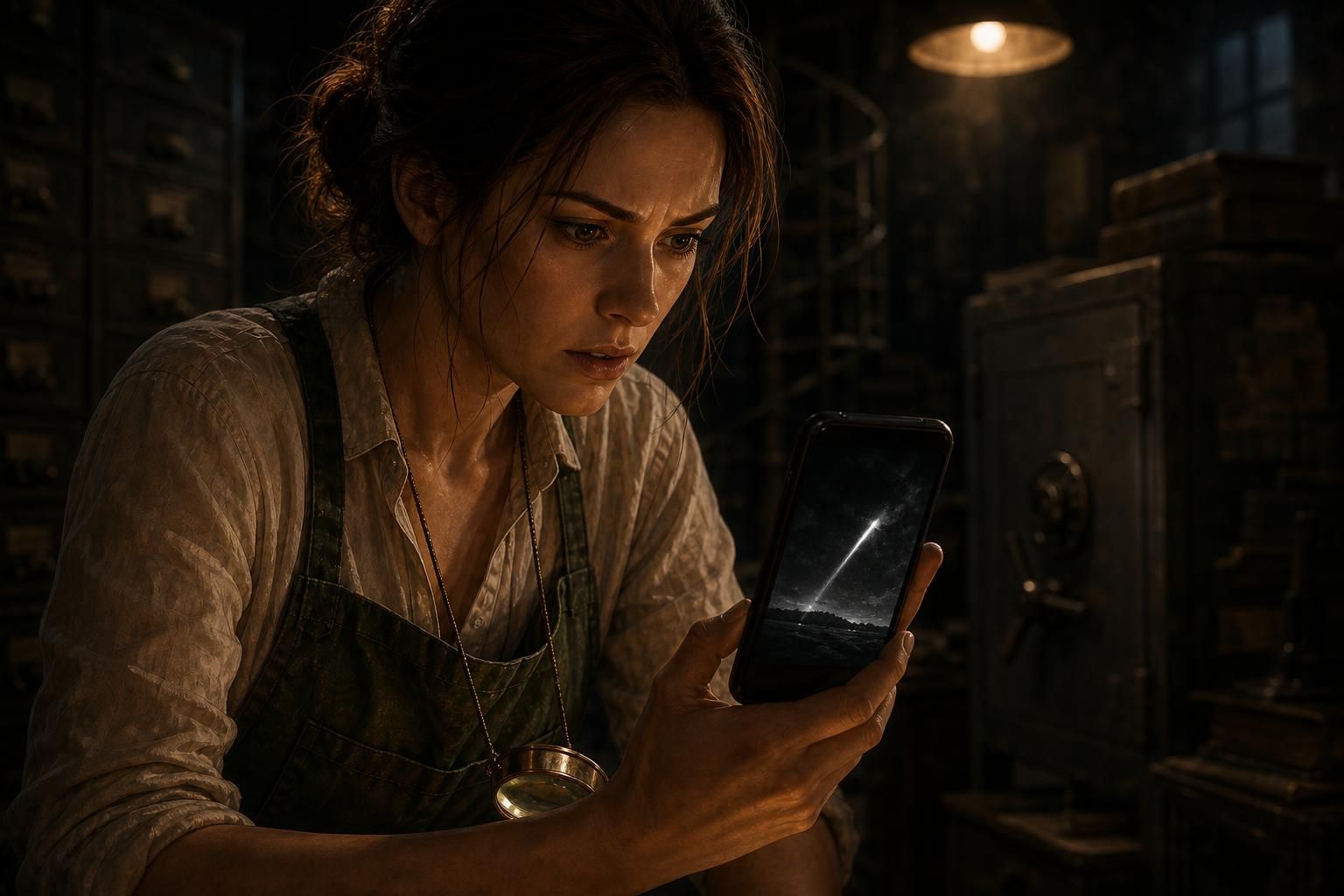
Elara stands in the basement, the brass key cold in her hand, staring at her phone. The email's warning echoes in her mind. Outside, through a high basement window, a faint, steady light blinks in the night sky—exactly at the coordinates she found. It is not a star. And it is watching.

