

Dark Romance Serial
The Third Guest at Tarn House
A widow renting a remote manor discovers she is not alone—the dead artist who painted its rooms still watches through his work.
A grieving widow rents a secluded manor in the Lake District and finds herself drawn to the ghost of the painter who once lived there—a dangerous love across the veil.
This is a fictional story. All characters are adults. Any resemblance to real persons, places, or events is coincidental.
Part 1: The Signature in the Corner
A widow renting a remote manor discovers she is not alone—the dead artist who painted its rooms still watches through his work.
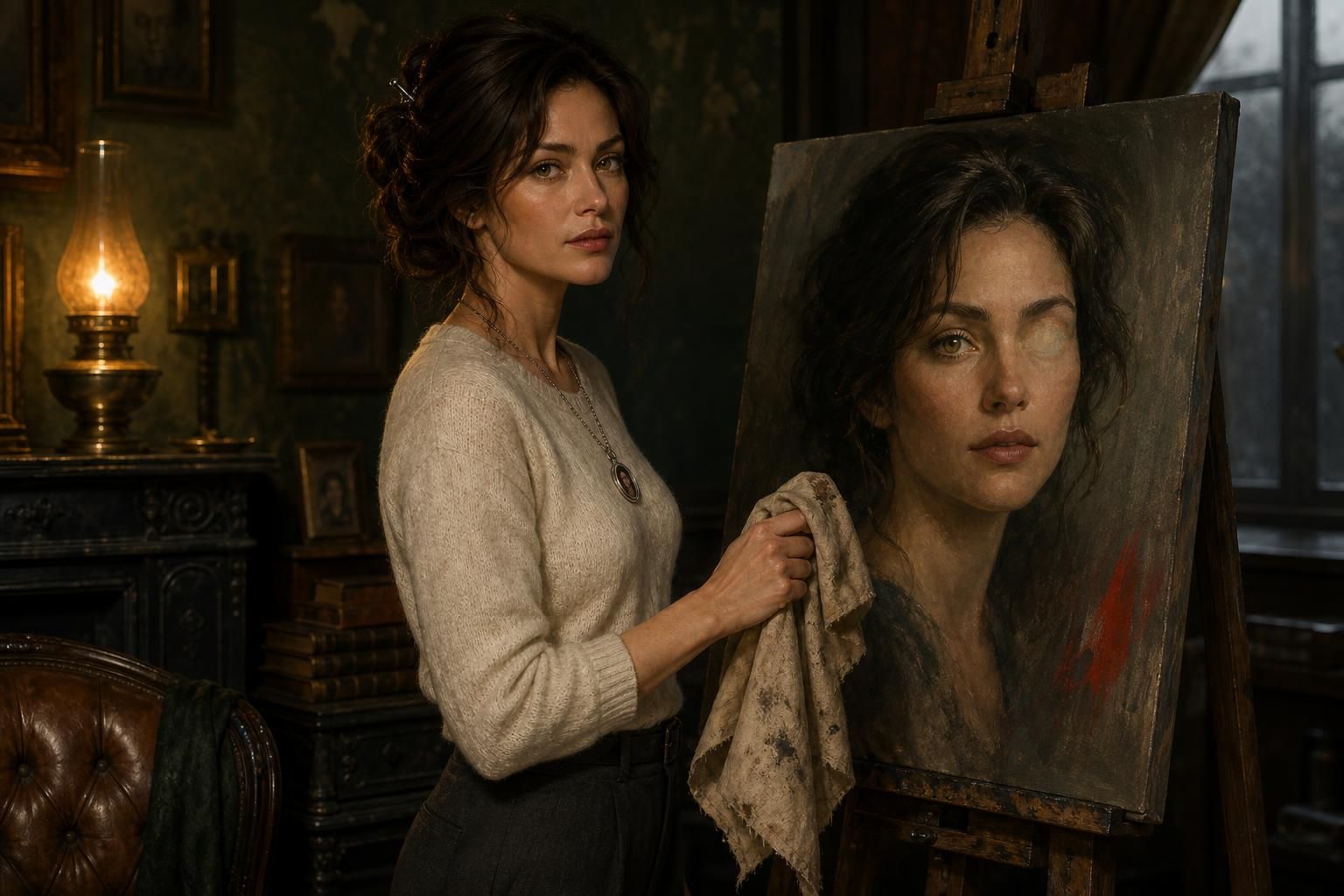
The key turned with a sound like a bone breaking. Isla Venn pushed open the heavy oak door of Tarn House and stepped into a silence so complete it felt like held breath.
She had come here to forget. Six months of solitude, a sabbatical from grief, a chance to restore the broken pieces of herself the way she restored paintings—patiently, with steady hands, one layer at a time. Her husband's locket lay cold against her collarbone, a silver weight she had not removed in ten months.
The manor swallowed her footsteps. Dust motes danced in the grey afternoon light that filtered through tall windows overlooking the tarn. The air smelled of old wood, turpentine, and something floral she could not name.
It was Liam Thorne who met her in the entrance hall. He was broader than she expected, with a weathered face and grey eyes that seemed to hold the same mist that clung to the lake. His handshake was brief, calloused, and he released her fingers as if they burned him. "The study's through there," he said, nodding toward a door at the end of the corridor. "I'd leave it closed if I were you."
"Why?"
He did not answer. He simply turned and walked out into the rain.
Isla ignored his warning. She was a conservator; closed doors were invitations. She found the study exactly as she had imagined—high ceilings, a cold fireplace, shelves of leather-bound books, and in the center of the room, a canvas draped in a dust cloth that had yellowed with age.
She pulled the cloth away.
Her breath stopped.
The painting was unfinished. A woman's face emerged from the oils with unsettling immediacy—the left eye complete, hazel with a fleck of gold, staring outward with an intensity that made Isla's skin prickle. The right eye was a blank oval of primer. The hair was dark chestnut, pinned loosely with a silver clip that matched the one in Isla's own hair.
The resemblance was not vague. It was exact.
Isla's hand trembled as she lowered the cloth. Her own face looked back at her from a canvas that must have been painted twenty years ago, before she was born.
A cold breath touched the nape of her neck. She spun around.
The room was empty. The windows were sealed. And yet the air had grown colder, heavier, as if a presence had pressed itself against her back.
She looked back at the painting. The finished eye seemed to follow her—not in the way painted eyes always do, but deliberately, with the weight of a gaze that wanted to be seen.
Isla's fingers moved without permission. She reached out and touched the painted iris.
The eye shifted. It looked directly at her.
The locket at her throat grew warm.
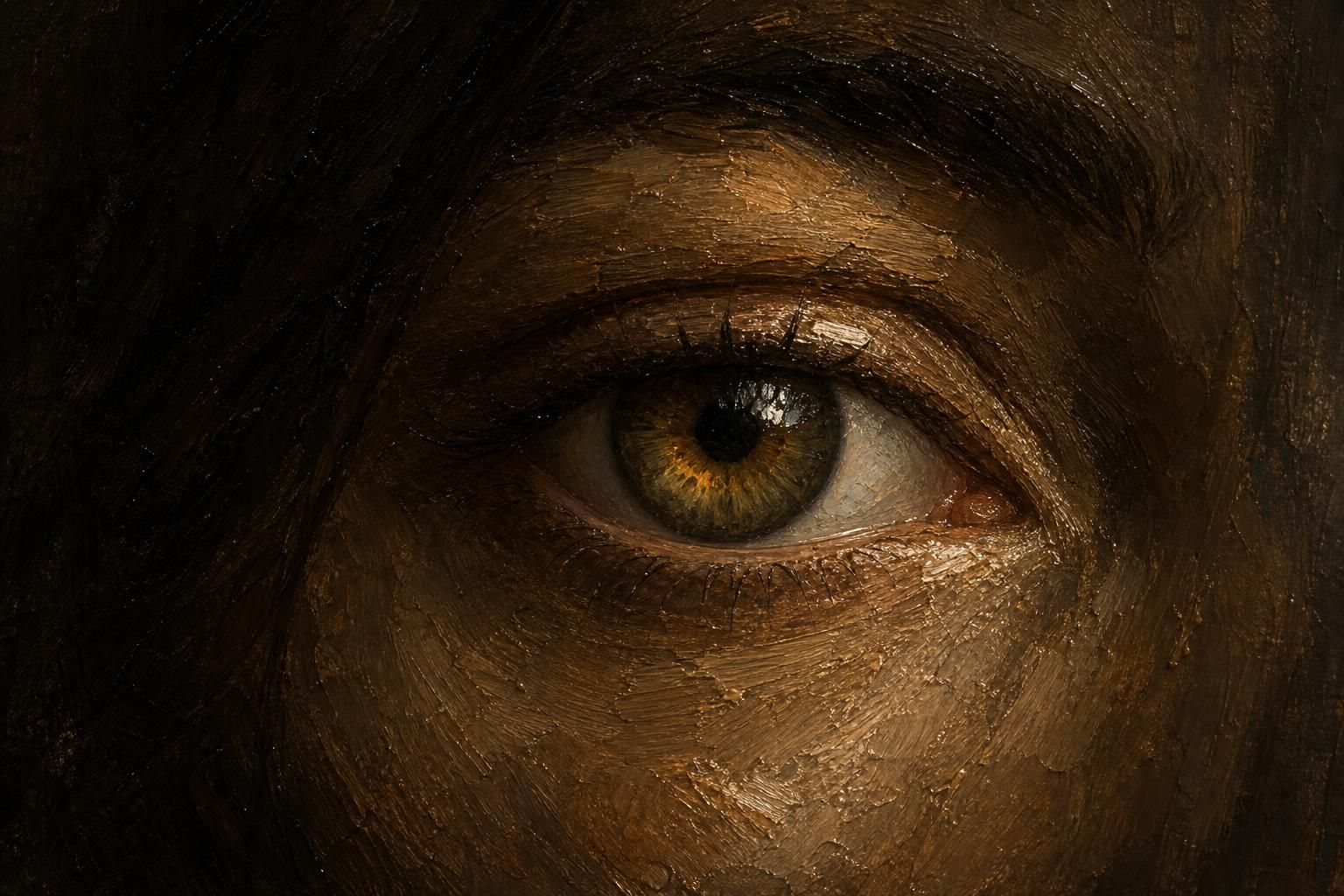
Isla touches the painted eye, and the iris shifts to look at her directly.
Part 2: The Color of a Touch
To restore the portrait, she must first let it touch her.
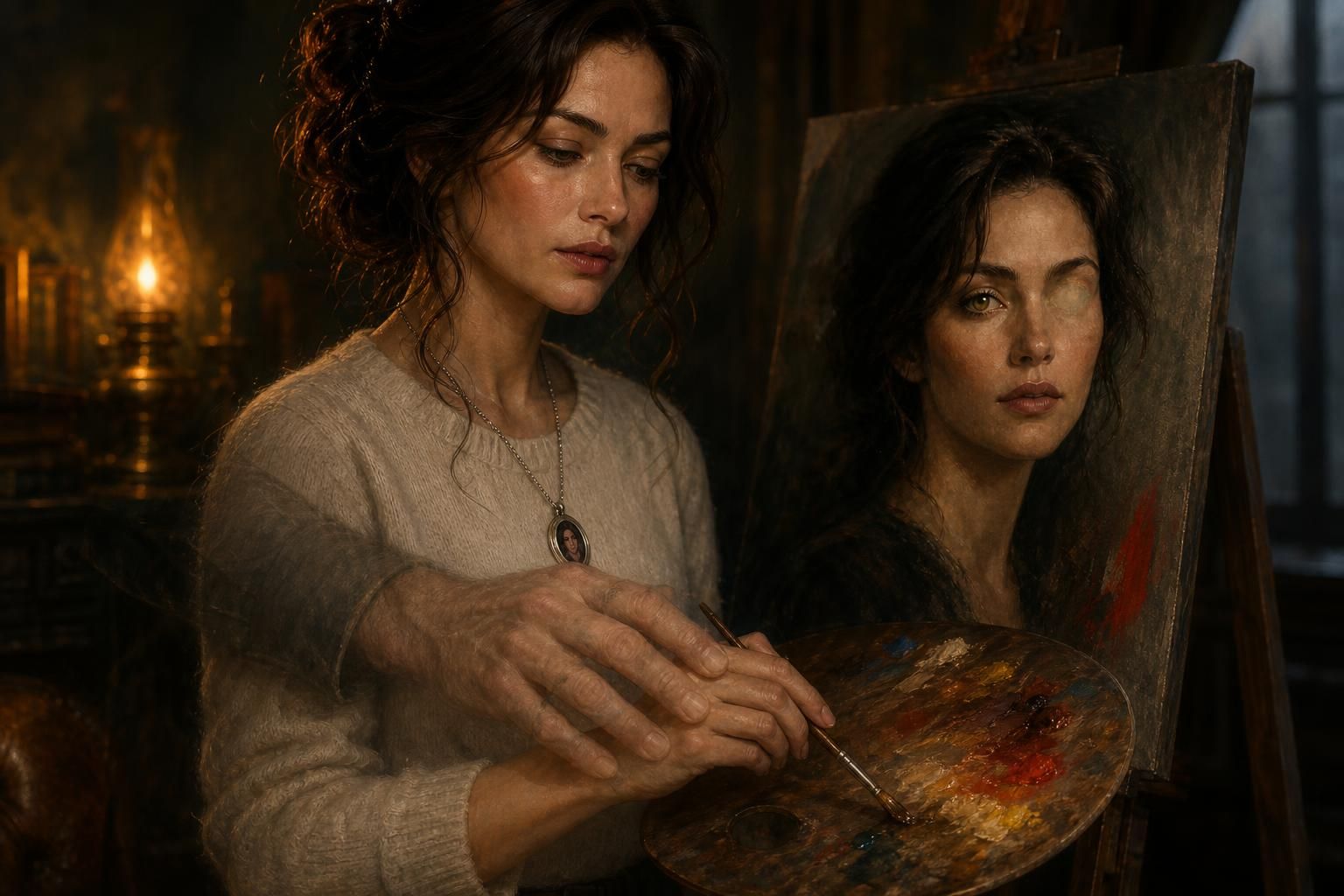
The study smelled of cold dust and old turpentine. Isla had spent the morning clearing the shelves, cataloguing dried brushes in a cracked jar, and trying not to look at the painting. But the canvas pulled at her like a held breath.
She found a note tucked behind the frame, yellowed and brittle: *J. Ashworth, 2004. Unfinished. Do not sell.* Below it, in the same hand: *She will know what to do.*
Her fingers trembled as she touched the scrawled date. He had died in the boathouse fire that same year. The woman in the portrait could not be her—yet the curl of the lips, the fleck of gold in the left iris, were hers exactly.
She began to clean the surface with a soft cloth, working from the top down. The paint was thick, alive with texture. As she reached the unfinished eye—a hollow socket of raw canvas—she felt a shift in the air. Footsteps on the floorboards. A warmth at her shoulder, like a palm hovering an inch from her skin.
She spun around. Nothing. But her reflection in the window showed a faint blur of movement behind her, and she smelled woodsmoke and wet wool.
Liam found her an hour later, her hands stained with linseed oil, her hair escaping its silver clip. He stood in the doorway, grey eyes fixed on the portrait with a hungry confusion he could not hide.
“You’re cleaning it,” he said, his voice rough.
“I’m a conservator. I can’t let it rot.”
He stepped closer, and she caught the scent of autumn leaves on his coat. Without thinking, she asked, “Did you know him? Julian Ashworth?”
Liam’s jaw tightened. “I knew the house. The stories. He was a recluse.” He paused, then added, almost to himself, “I used to paint. Before I came here.”
He taught her a pigment-mixing technique—how to grind cobalt and bone black into a warm grey that matched the portrait’s shadows. His hand brushed hers as he passed the palette, and a jolt went through her, raw and unbidden. She looked up. He was staring at the painted face as if remembering something he could not name.
That night, Isla dreamed.
She was standing in the study, but the room was warmer, the walls hung with unfinished sketches. A man stood at the easel—Liam, younger, his hands stained with vermilion. He turned, and his grey eyes held gold flecks that swam like embers. “Don’t move,” he said, and she felt the brush touch her collarbone, leaving a trail of heat.
She woke gasping. Her hair smelled of turpentine.
She had never used turpentine in her life.
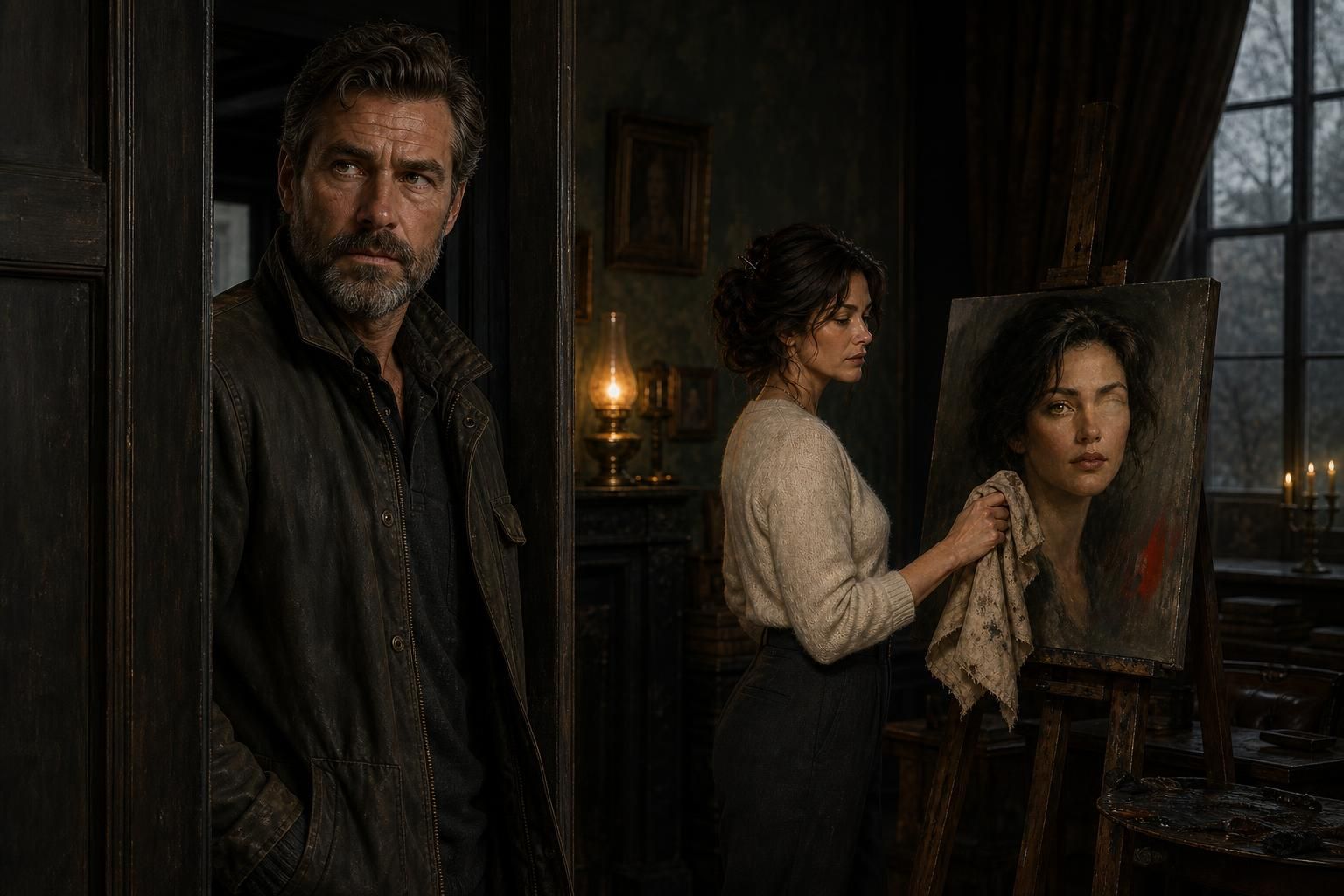
Isla wakes from the dream with her hair smelling of turpentine—she has never used turpentine in waking life.
Part 3: The Unfinished Eye
The dead painter’s sketchbook holds every face Isla has ever worn—and the truth behind the man who tends the grounds.
The attic stairs groaned under Isla’s weight as she climbed, the dust of decades settling into her lungs. She had found the key on Julian’s old desk, tucked beneath a dried rose. The sketchbook lay in a cedar chest—leather-bound, warped by damp, its pages yellowed and brittle.
She opened it.
Every face was hers.
Not a resemblance—a precise portrait. The same heart-shaped jaw, the same hazel eyes with the gold fleck in the left iris. Dated: 2002, 1997, 1989. Years before she was born. Years before she could have existed anywhere but in Julian Ashworth’s imagination.
Her hand trembled. She turned to the final page: a sketch of a woman on a dock, dropping a locket into dark water. The woman’s hair was pinned with a silver clip.
The locket around her own throat felt suddenly heavy.
She found Liam in the study, staring at the unfinished portrait. The afternoon light fell across his weathered face, catching the grey of his eyes.
“You knew,” she said. “You’ve always known.”
He turned slowly. His hand rose to the canvas, fingertips brushing the painted collarbone. And then his breath caught—a gasp that shook his shoulders.
“The fire,” he whispered, voice raw. “I was in the fire. I ran back for the painting. The roof—I remember the roof collapsing. And then… nothing. Just the grounds. The tarn. Waking up with my hands burned and a name that wasn’t mine.”
Isla stepped closer. “Liam—”
But the air between them shifted. A warmth gathered, a presence. And Julian Ashworth stepped out of the shadow beside the armoire.
He was identical to Liam: the same broad shoulders, the same salt-and-pepper beard, the same grey eyes. But his form was translucent, edges soft as smoke. He wore no coat—only a paint-stained shirt, open at the collar.
“I never left,” Julian said. “The fire split me. One body survived, one spirit stayed trapped in the painting. To finish it is to fuse us again. But the cost is yours, Isla.”
She touched the locket. Inside, a watercolor of a mountain lake—the place she and her husband had planned to visit before the accident.
“You have to let go of the locket,” Julian said softly. “Grief is a door. You can stand in it forever, or you can walk through.”
Isla’s vision blurred. She thought of her husband’s laugh, of the hollow space beside her in bed. And then she thought of Liam’s hands teaching her to mix pigment, of the dream where she was painted into being by someone who had been waiting for her all along.
She unclasped the locket. It rested in her palm, silver and warm.
Then she walked to the portrait. The missing eye—the left eye—lay empty, a void of raw canvas. She dipped a fine brush into vermilion. Her hand did not shake.
She painted the final stroke.
The eye opened on the canvas, hazel and gold, alive.
And beside her, Liam’s grey eyes flashed gold—once, twice—and settled into the colour of autumn leaves. He blinked. He looked at his own hands. He looked at Isla.
“Julian,” she whispered.
“Liam,” he corrected, his voice sure now. “Both of us. One life.”
He reached for her hand. She let him take it.
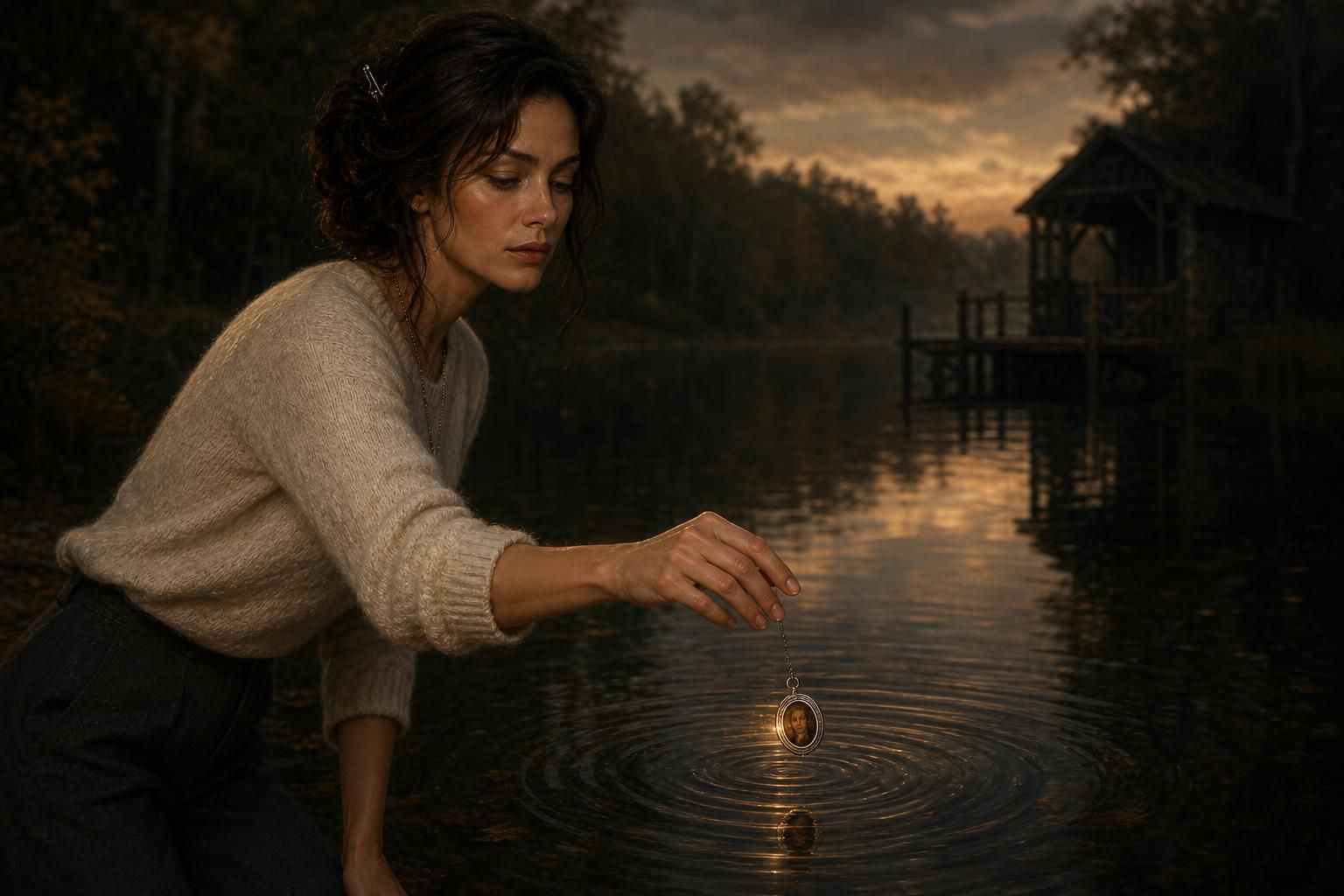
That evening, they walked to the boathouse dock. The tarn lay still as black glass, reflecting the last apricot light of the sky. Isla held the locket one final time.
She opened her fingers.
The silver caught the sun—a flash of gold—and then it sank, ripples spreading outward, dissolving into the deep. The water closed over it like a held breath released.
When Isla turned, Liam was watching her, his mouth soft with something between wonder and gratitude. Behind them, through the study window, the completed portrait glowed—a woman with a silver clip in her hair, stepping forward as if she might leave the frame.
On a fresh canvas, propped against the dock railing, a single brushstroke of ultramarine blue waited. A beginning.
They were both still learning how to start again.

Isla and Liam stand together on the boathouse dock, the tarn mirroring a single autumn sun; the locket rests at the bottom of the water. The painting is complete, and a new one begins on a fresh canvas.

