

Urban Legend Serial
The Red Door on Rivington Street
They say if you knock three times and whisper your greatest regret, the door opens—but you must leave something behind.
A woman searching for closure finds the legendary red door on Rivington Street—and must decide what piece of herself she's willing to trade to undo her worst decision.
This is a fictional story. All characters are adults. Any resemblance to real persons, places, or events is coincidental.
Part 1: The Rule of the Red Door
They say if you knock three times and whisper your greatest regret, the door opens—but you must leave something behind.
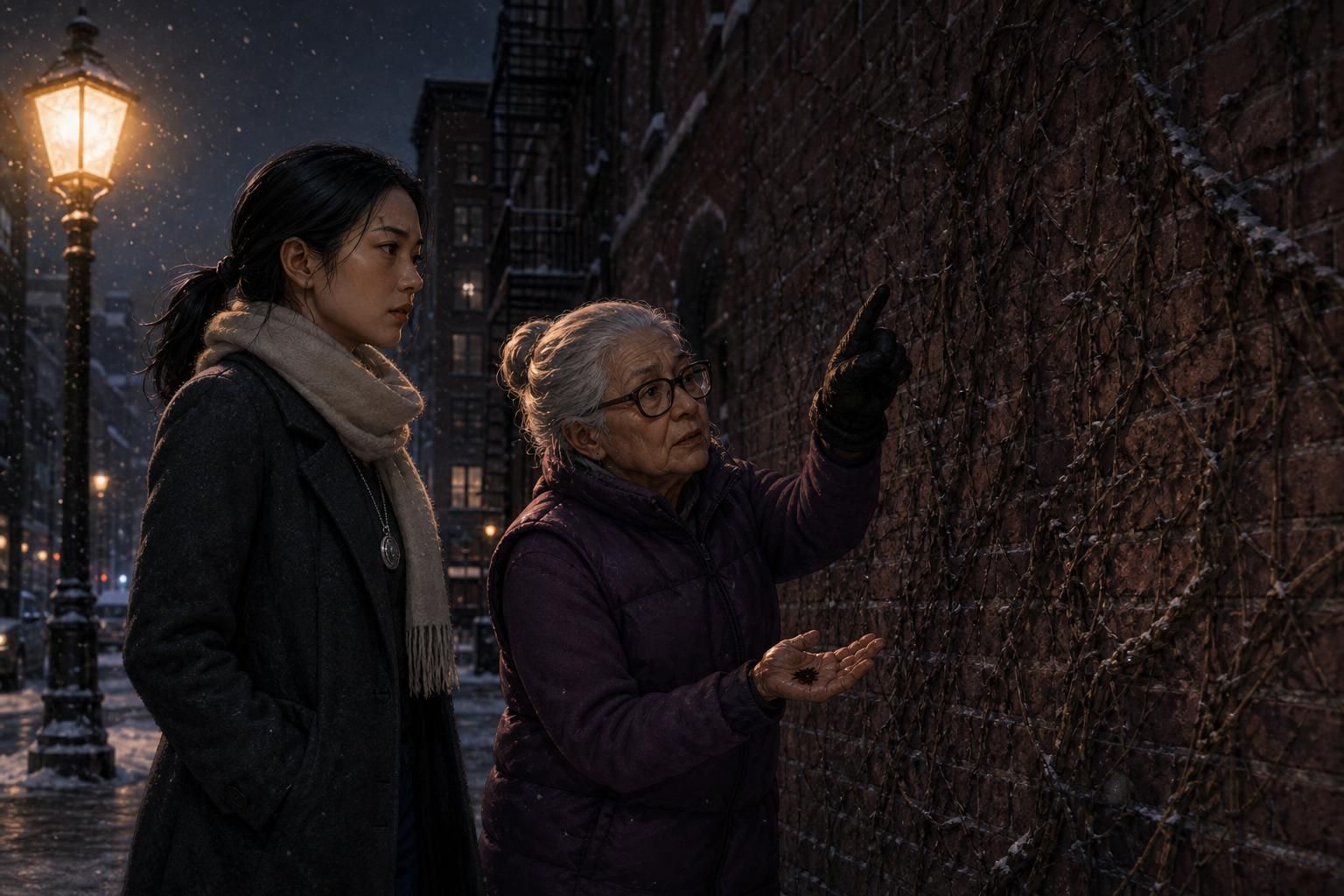
The snow fell in thin, dry flakes, each one a tiny ghost dissolving on Nora Chen's wool coat. She walked the last block to her apartment on Rivington Street with her hands shoved deep in her pockets, the cold biting at her cheeks and the tip of her nose. A single streetlamp cast a yellow pool of light on the sidewalk, illuminating the figure of an old woman standing perfectly still before a blank brick wall.
Nora slowed. The woman was short and stooped, her silver hair pinned in a tight bun, a purple down vest zipped over a thick sweater. Her left hand was gloveless, raised as if to touch the bricks, and in the amber light Nora saw a large, dark birthmark on her palm, shaped like a teardrop.
"Excuse me," Nora said. "Are you all right?"
The woman turned. Her eyes were pale blue, sharp and clear behind thick-rimmed glasses. "I'm waiting," she said, her voice thin as winter wind. "For the door."
Nora followed her gaze to the wall. It was a solid stretch of old brick, covered in the tangled bones of dead ivy. No door. No window. "There's nothing there," Nora said gently.
The woman smiled. "Not yet. But you're looking with your eyes, not your regret."
She introduced herself as Mrs. Callahan, a neighbor who had lived on this street for fifty years. Then she told Nora the story.
"On this street, there is a red door," she said, her voice dropping to a near-whisper. "It only appears to those who truly regret something. You must knock three times and whisper your deepest regret. The door will open, but you must leave something precious behind. And then… the thing you regret never happened."
Nora laughed softly, the sound lost in the snow. "That sounds like a folk tale. Something you tell tourists."
Mrs. Callahan studied her for a long moment. "You have a silver locket," she said. "Who's inside?"
Nora's hand went to her collarbone, where the locket lay warm against her skin. She didn't answer.
"I thought so," Mrs. Callahan said. She turned back to the wall. "If you ever want to open the door, you'll know the rule. And you'll know what to leave behind."
Nora walked away, her boots crunching in the snow. She told herself it was just the rambling of an old woman. But that night, as she unlocked her apartment door, she found a dried persimmon on the windowsill. It was shriveled and brown, a tiny, withered fruit. She hadn't put it there. Samir used to bring her persimmons from the farmer's market every autumn. They had a spot under a persimmon tree in a community garden in the East Village, where they'd sit and argue about everything and nothing, and then kiss until their lips were numb.
The last fight had been about his photography. He wanted to move to Berlin for a year-long documentary project. She said it was reckless, that they couldn't afford it. He said she was afraid. She said he was selfish. He left. She stayed. And she had regretted every word of that argument for three years.
The next morning, Nora's phone buzzed. A mutual friend had posted a photo on social media: Samir at JFK, a suitcase at his feet, a final shot of the Manhattan skyline through the terminal window. The caption read: "Last view of New York. Berlin, here I come."
Nora stared at the screen until her eyes blurred. The regret rose in her throat like bile. She had let him go. She had chosen pride over love. And now he was leaving the country, and she would never get the chance to say she was sorry.
She didn't think. She grabbed her coat, didn't bother to change out of her slippers. She ran down the stairs, out into the snow, and back to that blank brick wall on Rivington Street. The street was empty. The streetlamp flickered.
She raised her fist. Knocked three times.
"I regret walking away from Samir," she whispered.
The brick wall rippled like water. A seam of light appeared, outlining the shape of a door that had not been there a moment before. The red paint was deep and vibrant, the color of a heart beating under skin. A brass knocker in the shape of a closed eye gleamed in the darkness. The door swung open, just a crack, and warm light spilled out onto the snow.
Nora reached for it.
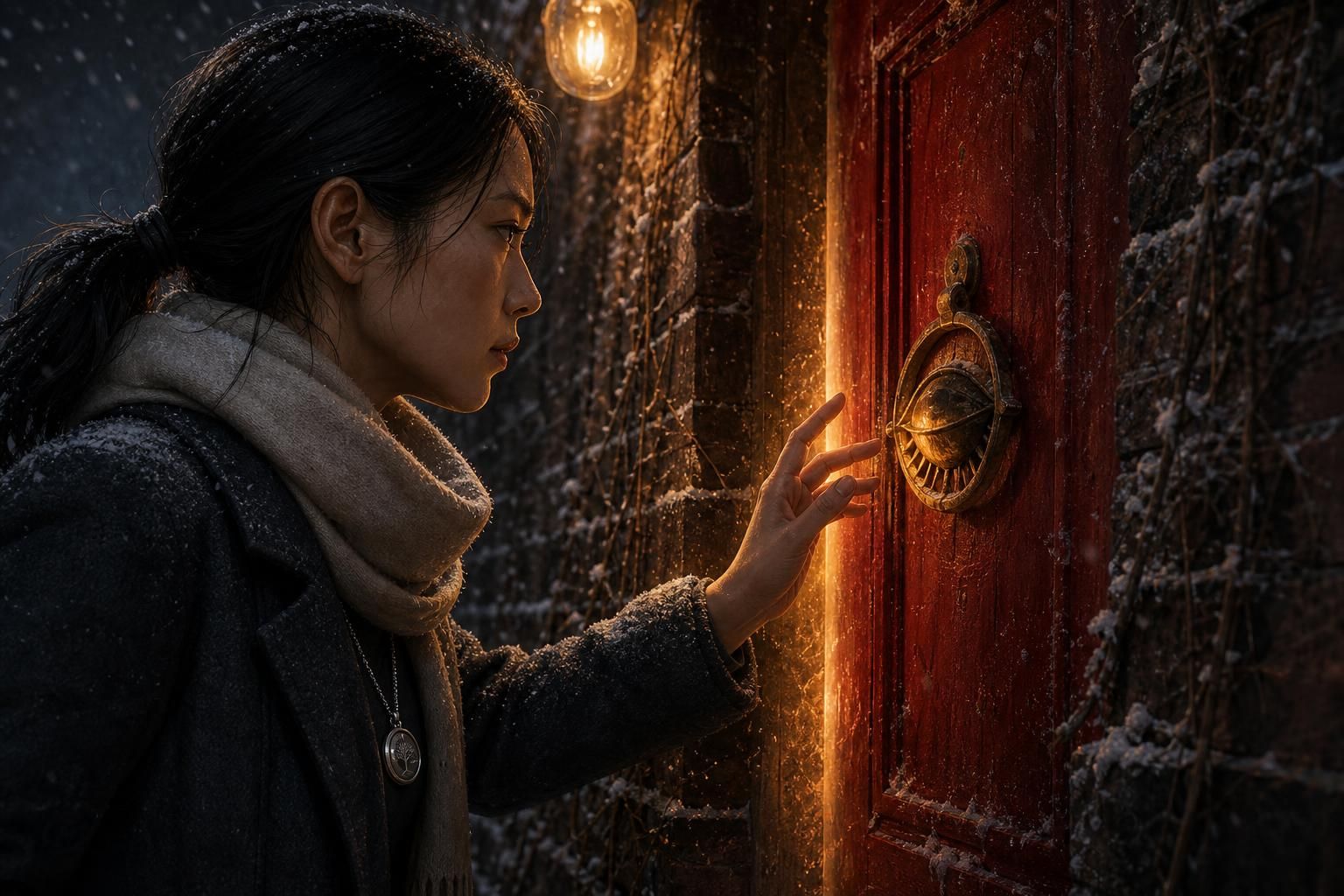
Nora reaches for the red door as it materializes, her fingers inches from the brass knocker shaped like a closed eye.
Part 2: What the Mirror Shows
Nora steps inside and finds a life she could have had—but the cost is more than she imagined.
The red door swung open without a sound. Nora stepped over the threshold into warmth that smelled of dust and dried persimmons. The door clicked shut behind her, and the brick wall she had known was gone. She stood in a small, windowless room with a single piece of furniture: a full-length mirror in a tarnished silver frame.
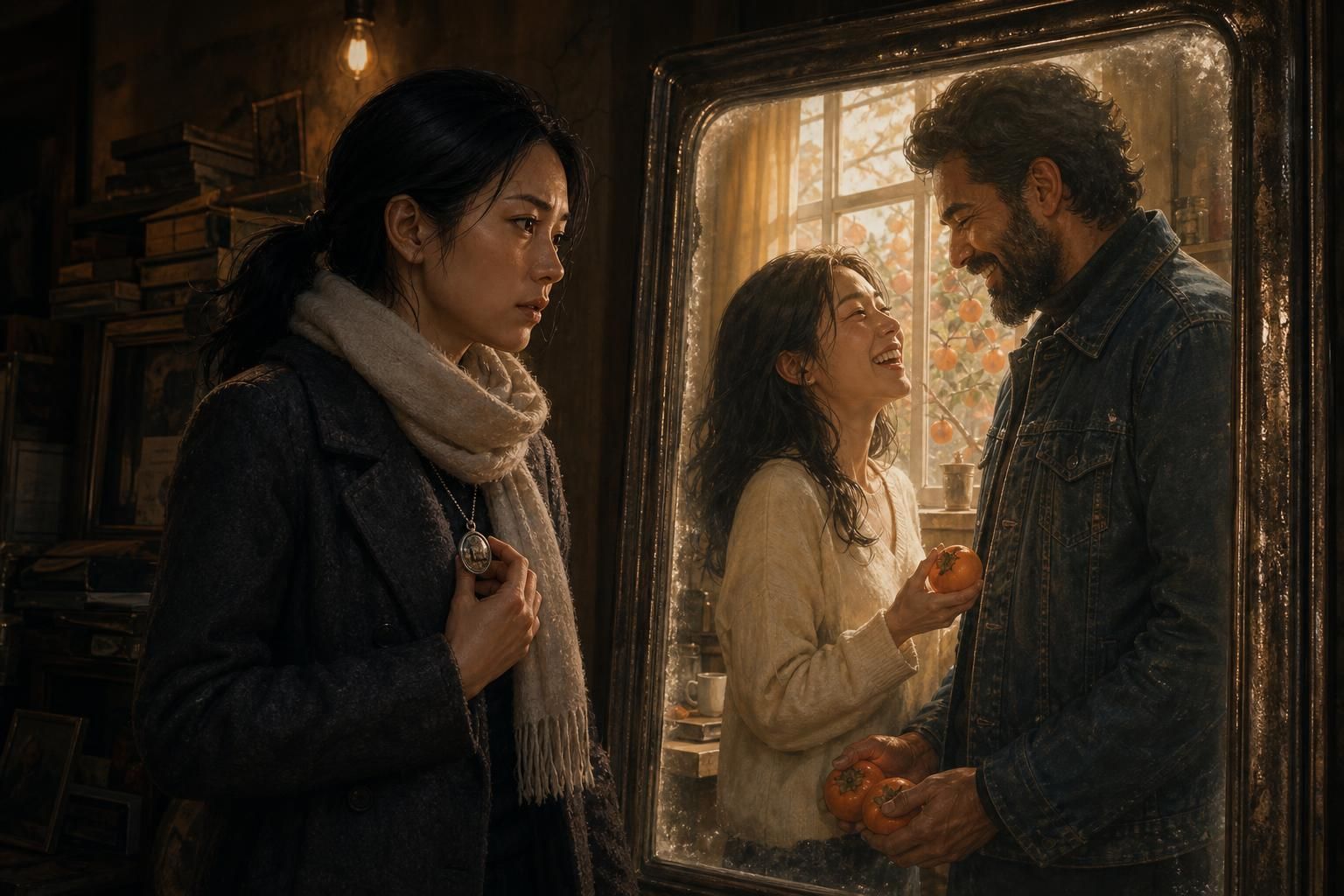
Her reflection did not match her. The woman in the mirror wore a soft cream sweater instead of Nora's charcoal coat. Her hair was loose, not in its usual ponytail. And she was laughing—a bright, unguarded laugh Nora had not heard from herself in years.
The mirror shimmered, and the reflection deepened into a scene: a sunlit kitchen with yellow curtains, a wooden table cluttered with sketchbooks and camera lenses, and beyond the window, a persimmon tree heavy with fruit. Samir sat at the table, his beard dusted with flour, holding up a misshapen loaf of bread as if it were a trophy. The reflected Nora leaned over his shoulder, her hand on his, and kissed his cheek. Samir looked up at her with an expression of pure, unguarded love.
Nora's breath caught. She pressed her palm against the glass, and the reflection rippled like water.
"That is the life you could have." Mrs. Callahan's voice came from the shadows behind her. Nora spun, but the old woman was not there—her voice came from everywhere, as if the room itself spoke. "You whisper your regret, and the door shows you the road not taken. To step through the glass, you need only leave behind what you have carried since that moment."
"The locket," Nora whispered. She touched the silver oval through her scarf.
"The locket holds your memory of the years after you walked away. Every lesson, every scar, every quiet night you learned to love yourself—all of it. Leave it on the floor, and the mirror will open. You will step into that kitchen, and you will remember nothing of the life that led you here. You will be the Nora who never left."
Nora's fingers tightened around the locket. Inside was a tiny photo of the persimmon tree at their favorite spot—a memory she had carried like a wound. But the locket also held the afternoon she had spent learning to fix her own leaky faucet, the freelance project that had won her a design award, the evening she had danced alone in her apartment to an old jazz record, crying and smiling at the same time. It held three years of becoming someone she barely recognized—someone she had started to like.
She looked at the mirror. The laughing Nora in the kitchen did not know about the broken nights, the sudden tears in the grocery store, the slow rebuilding. That Nora had never discovered her own strength.
The room grew warmer. The scent of persimmons thickened. The mirror seemed to pulse, inviting her, promising a life without the ache.
Nora unclasped the locket. It lay in her palm, warm and heavy as a heart.
She lowered her hand toward the floor.
The red door behind her exploded open. A blast of cold air swept through the room, carrying the scent of snow and city grit. Samir's voice cut through the stillness, raw and desperate.
"Nora! Don't!"
She turned. Samir stood in the doorway, his denim jacket dusted with snow, his Leica camera swinging from his neck. His eyes were wide, his breath forming clouds in the cold air that now warred with the warm, perfumed air of the room. He reached for her.
Behind him, the mirror began to crack. A thin line spiderwebbed across the glass, and the laughing Nora froze, her smile turning to a stare of blank astonishment.
Nora's hand stopped an inch from the floor. The locket swung from her fingers like a pendulum, and she looked from Samir's face to the shattered mirror, caught between two lives.
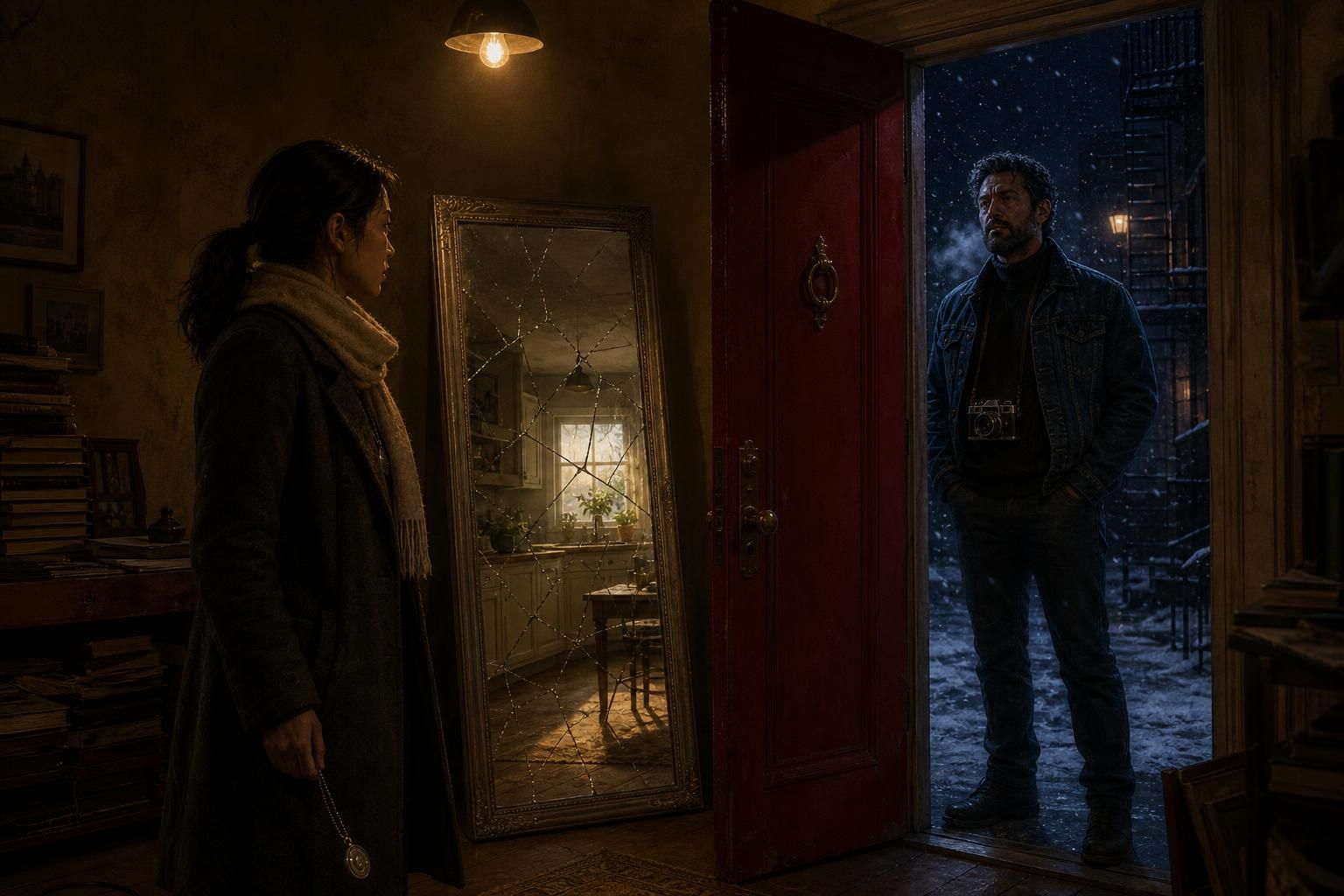
As Nora is about to drop the locket, Samir bursts through the door behind her, shouting her name, and the mirror-world begins to crack.
Part 3: The Keeper's Price
The mirror cracks, the keeper steps forward, and Nora must choose between a perfect past and an imperfect life.
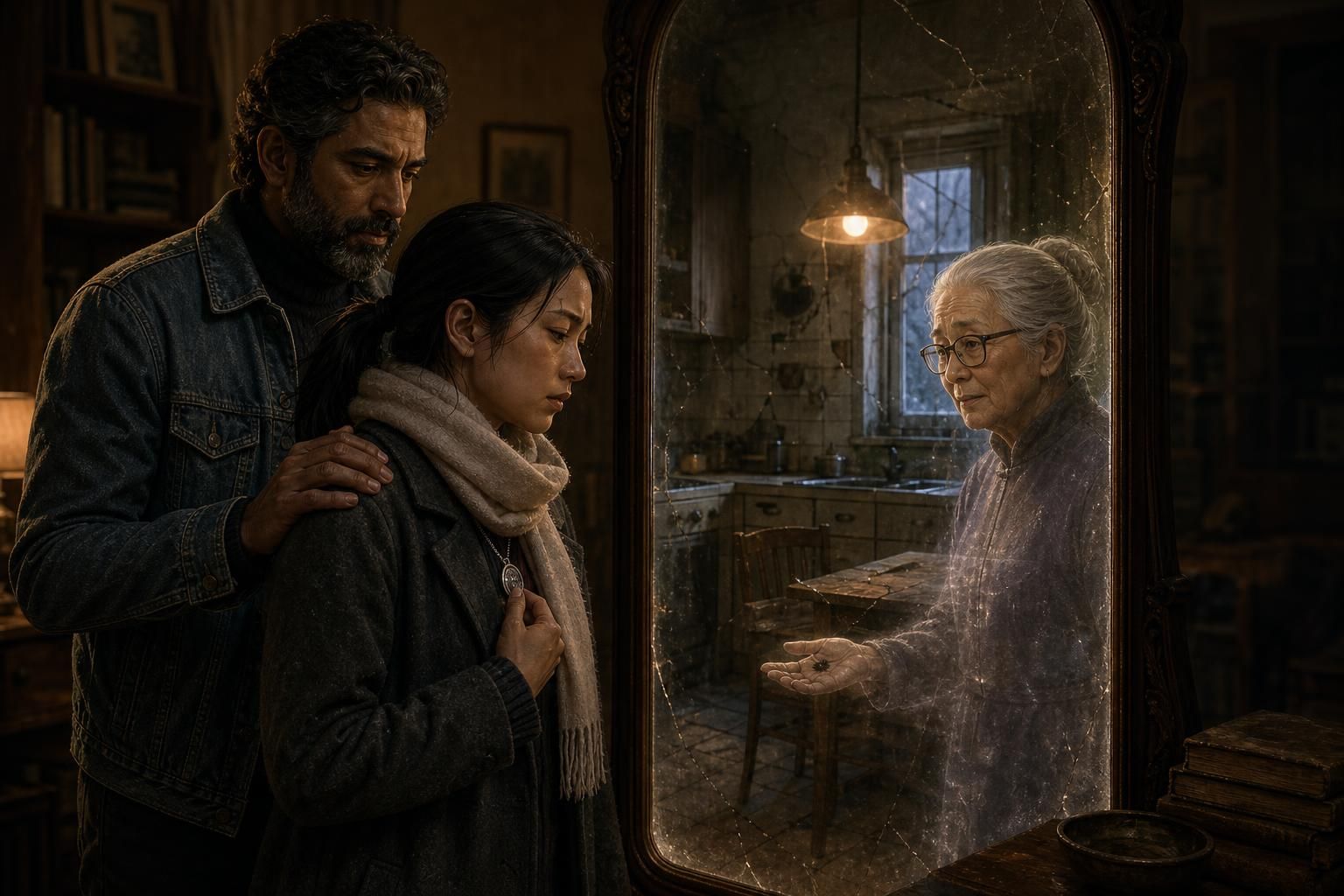
The mirror-world shuddered. A web of fractures spread across the reflection of Nora and Samir laughing in that sunlit kitchen. Nora felt the locket cold against her palm, the chain still around her neck.
From the shadowed corner of the room, a figure emerged. Mrs. Callahan, but not the Mrs. Callahan Nora had met on the snowy street. This version was younger—perhaps sixty, not seventy-eight—and her eyes held a deep, ancient weariness. Her purple down vest was gone, replaced by a simple gray dress. The teardrop-shaped birthmark on her palm glowed faintly.
"You're the keeper," Nora whispered.
Mrs. Callahan nodded slowly. "Forty years ago, I knocked. I whispered my regret—a daughter I had wronged. The door showed me a life where she forgave me. All I had to do was leave behind the memory of the years I spent alone." She held up her hand, palm open. "But the door doesn't take regret. It takes the memory that made that regret possible. I dropped my wedding ring, and I forgot my husband's face. By the time I understood, I could not leave. I became the keeper, guiding others who came seeking the same foolish trade."
Samir stepped forward, his breath still fogging in the unreal air. His vintage Leica hung at his side, and his voice was raw. "Nora, I came because Mrs. Callahan told me where you'd gone. I came to bring you back."
"Back to what?" Nora's voice cracked. "Back to the fight that ended us?"
"No," Samir said. "Back to now. Back to the person you became after we broke up. I was stubborn. I was wrong. But I don't want to undo that night—I want to build something new. Starting with the woman standing in front of me, who has three years of scars and art and snow and persimmon petals that made her who she is."
Nora's fingers tightened around the locket. The mirror showed Samir's reflection, reaching for her. But the real Samir was here, his warm brown eyes pleading, his hand outstretched.
She looked at Mrs. Callahan. "If I don't trade, what happens to you?"
Mrs. Callahan smiled—a sorrowful, radiant smile. "I have been here so long, I am more keeper than woman. But when a soul chooses to walk away, the door weakens. It may finally let me go."
Nora let the locket fall back against her chest. "Then I choose not to trade."
The mirror screamed. Not a sound, but a shattering sensation that ran through the room like a shockwave. The kitchen reflection dissolved into white light. The red door behind them began to glow, then flicker.
Mrs. Callahan's figure grew translucent. "Thank you," she whispered, her voice like wind through dead leaves. "Some doors stay closed for a reason." And then she was gone, a single red persimmon petal drifting to the floor where she had stood.
Samir grabbed Nora's hand. Together they stumbled through the red door—and emerged into the snowy street at dawn. The wall behind them was solid, unremarkable brick. No door. No knocker. Just a wet, cold morning and the sound of a distant subway train.
Nora opened her locket. Inside, where the tiny photo of the persimmon tree had been, there was now a single fresh red petal. She touched it, and the edges of her memory—the fight, the silence, the years of grief—seemed to soften, as if forgiven.
Samir wrapped his arms around her. His coat smelled of old coffee and winter air. She pressed her face into his shoulder and felt the weight of three years lift.
"Some doors stay closed for a reason," she repeated to herself, and they walked away together, their footprints the only mark on the pristine snow.
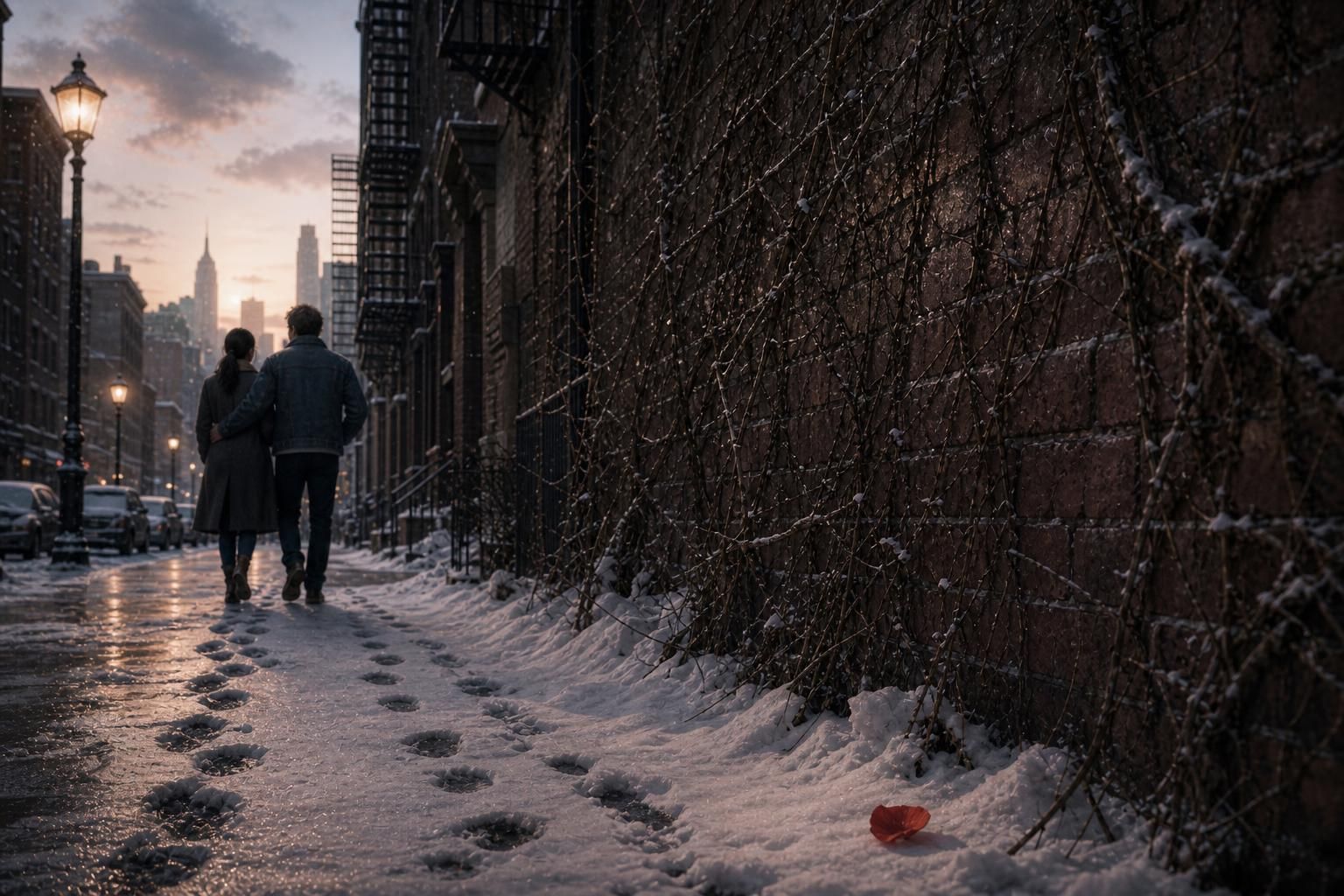
Nora and Samir walk away from the blank brick wall at dawn. Nora opens the locket to find a fresh persimmon petal inside. She whispers, 'Some doors stay closed for a reason.' The final image is the wall, bare and blank, with a single red petal on the snow behind them.

