

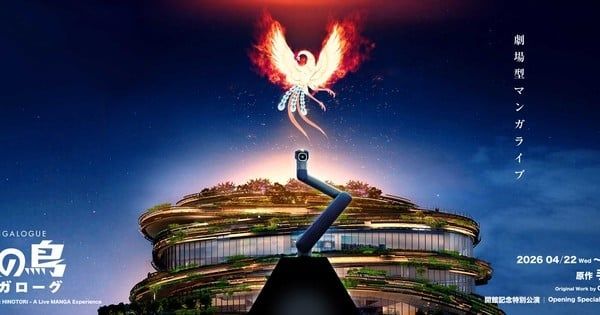
Tezuka's Immortal Phoenix Takes Flight in Groundbreaking Live Manga Performance

📷 Image source: animenewsnetwork.com
A Legendary Manga Reborn on Stage
Osamu Tezuka's Masterpiece Transformed into Live Art
In a unique fusion of traditional storytelling and contemporary performance art, the MoN Takanawa Museum in Tokyo is set to host a groundbreaking event. The museum will present a live manga performance based on Osamu Tezuka's seminal work, 'Phoenix' (Hi no Tori), from February 28 to March 1, 2026. This innovative production, titled 'Live Manga Performance: Phoenix,' aims to breathe dynamic, real-time life into the panels and pages of one of manga's most profound epics.
The event promises to be more than a simple reading or dramatic play. According to animenewsnetwork.com, the performance will feature live drawing, voice acting, and sound effects, creating an immersive experience where the comic narrative unfolds before the audience's eyes. This format seeks to capture the essence of manga's sequential art while injecting the immediacy and unpredictability of a live show. It represents a bold experiment in how classic graphic literature can be presented to new generations.
The Visionary Behind the Performance
Director Shōko Nakamura's Ambitious Undertaking
Spearheading this ambitious project is director Shōko Nakamura, a figure known for pushing the boundaries of theatrical expression. Nakamura's vision is to translate the philosophical depth and visual grandeur of Tezuka's 'Phoenix' into a singular sensory event. The report states that Nakamura and her team face the significant challenge of condensing the sprawling, multi-volume saga into a coherent live performance that honors its source material.
The choice of 'Phoenix' is particularly apt. Unlike Tezuka's more widely known works like 'Astro Boy,' 'Phoenix' is often considered his life's work—a complex, unfinished exploration of life, death, and reincarnation across different eras of human history. Adapting such a thematically dense and visually intricate series requires a deep understanding of its narrative threads and artistic philosophy. Nakamura's approach will likely focus on key arcs or thematic vignettes from the series to convey its essence within the constraints of a live performance.
Deconstructing the 'Live Manga' Format
How Art, Voice, and Sound Converge in Real Time
The core innovation of this event lies in its 'live manga' format. But what does that entail in practice? The performance will involve artists drawing key illustrations or sequences on large surfaces, possibly with digital projection, synchronized with voice actors delivering dialogue and narrators guiding the story. Sound designers will create atmospheric effects and music live, completing the multi-layered experience.
This process turns the typically private, static act of reading a manga into a public, kinetic spectacle. The audience witnesses the creation of the art in tandem with the progression of the story, adding a layer of craftsmanship and spontaneity. It bridges the gap between the reader's imagination and the artist's hand, offering a behind-the-scenes look at the narrative construction while being swept up in the drama itself. The technical coordination between drawers, voice actors, and technicians must be flawless to maintain the story's flow and emotional impact.
The Enduring Legacy of Tezuka's Phoenix
Why This Manga Continues to Captivate
To understand the significance of this event, one must appreciate the stature of 'Phoenix' within Japanese pop culture and beyond. Osamu Tezuka, often called the 'God of Manga,' worked on this series intermittently from the 1950s until his death in 1989. It remains unfinished, a fact that somehow amplifies its themes of eternal recurrence and the unending struggle of life. The manga spans epochs, from prehistoric times to a distant future, always centered on the mythical, immortal Phoenix bird whose blood grants eternal life.
According to animenewsnetwork.com, the series is renowned for its philosophical weight, exploring humanity's follies, its resilience, and its quest for meaning against the backdrop of immortality. Its artistic style evolved dramatically over Tezuka's career, making it a visual chronicle of his growth as an artist. This live performance is not merely an adaptation; it is the latest in a long line of homages and interpretations, proving the story's timeless relevance and its ability to inspire new artistic forms decades after its creation.
The MoN Takanawa Museum as a Stage for Innovation
A Venue Embracing Cross-Disciplinary Art
The choice of venue is no accident. The MoN (Museum of Nature and Science) Takanawa, while rooted in scientific exhibition, has cultivated a reputation for hosting interdisciplinary events that blend art, technology, and narrative. Its modern facilities provide the ideal technical infrastructure for a complex show involving live drawing, audio engineering, and potentially digital interactivity.
Hosting this performance aligns with a growing trend in museums worldwide to become active spaces for experiential art rather than passive repositories of objects. By staging 'Live Manga Performance: Phoenix,' the MoN Takanawa positions itself at the intersection of cultural heritage and innovative presentation. It offers a context where Tezuka's work can be appreciated not as a relic of pop culture history but as a living, breathing story that continues to evolve and find new modes of expression.
The Logistical Challenge of a Limited Run
A Brief but Intense Theatrical Engagement
The performance is scheduled for a concise run, with shows from February 28 to March 1, 2026. This limited engagement, as reported, heightens its exclusivity and likely places significant demand on ticket availability. For the production team, it means compressing immense preparation—rehearsing the synchronization of art, voice, and sound—into a short, intense period of public presentation.
Such a brief run is common for experimental theatre but poses questions about the event's legacy. Will it be documented for wider release, or is its ephemeral nature part of its artistic statement, mirroring the transient yet recurring lives depicted in 'Phoenix' itself? The report from animenewsnetwork.com, dated 2026-02-09T18:30:00+00:00, does not specify future plans, focusing instead on the announcement of this unique theatrical happening. This temporality makes attending the event a singular opportunity to witness a unique fusion of mediums.
Broader Implications for Manga and Performance Art
Pioneering a New Avenue for Graphic Storytelling
This live manga performance could have ramifications beyond this single event. If successful, it may pioneer a new genre of theatrical adaptation for graphic novels, distinct from anime screenings or stage plays based on manga. It validates the comic page as a direct script for a performance art piece, where the visual iconography is created in real time rather than pre-rendered.
It raises fascinating questions: Could other epic, visually distinctive manga like 'Berserk,' 'Vagabond,' or 'Akira' be adapted in a similar 'live drawing' format? Does this approach offer a more authentic bridge to the original artist's intent than full animation? The experiment at MoN Takanawa tests the waters, exploring whether audiences are captivated by the process of creation as much as by the finished story. It champions the artistry of manga-making itself, putting the labor of illustration—usually hidden in the studio—front and center on the stage.
A Testament to Tezuka's Unending Influence
Ultimately, 'Live Manga Performance: Phoenix' serves as a powerful testament to the enduring and flexible influence of Osamu Tezuka. Decades after his passing, his work continues to inspire artists to break conventions and merge forms. This event is not a nostalgic look back but a forward-thinking re-imagination. It treats 'Phoenix' not as a closed book but as an open source of inspiration, its themes of rebirth and eternity metaphorically reflected in its own continual adaptation.
For fans, it offers a novel way to connect with a classic. For newcomers, it provides a dramatic entry point into Tezuka's rich world. And for the world of performance art, it demonstrates that the language of comics is far more dynamic and adaptable than often assumed. As the artists prepare to bring ink and voice to life at the MoN Takanawa Museum, they are participating in the very cycle of death and rebirth that the Phoenix symbolizes, proving that great stories never truly end—they simply find new forms in which to rise again.
#Phoenix #OsamuTezuka #LiveManga #MangaPerformance #JapaneseCulture


